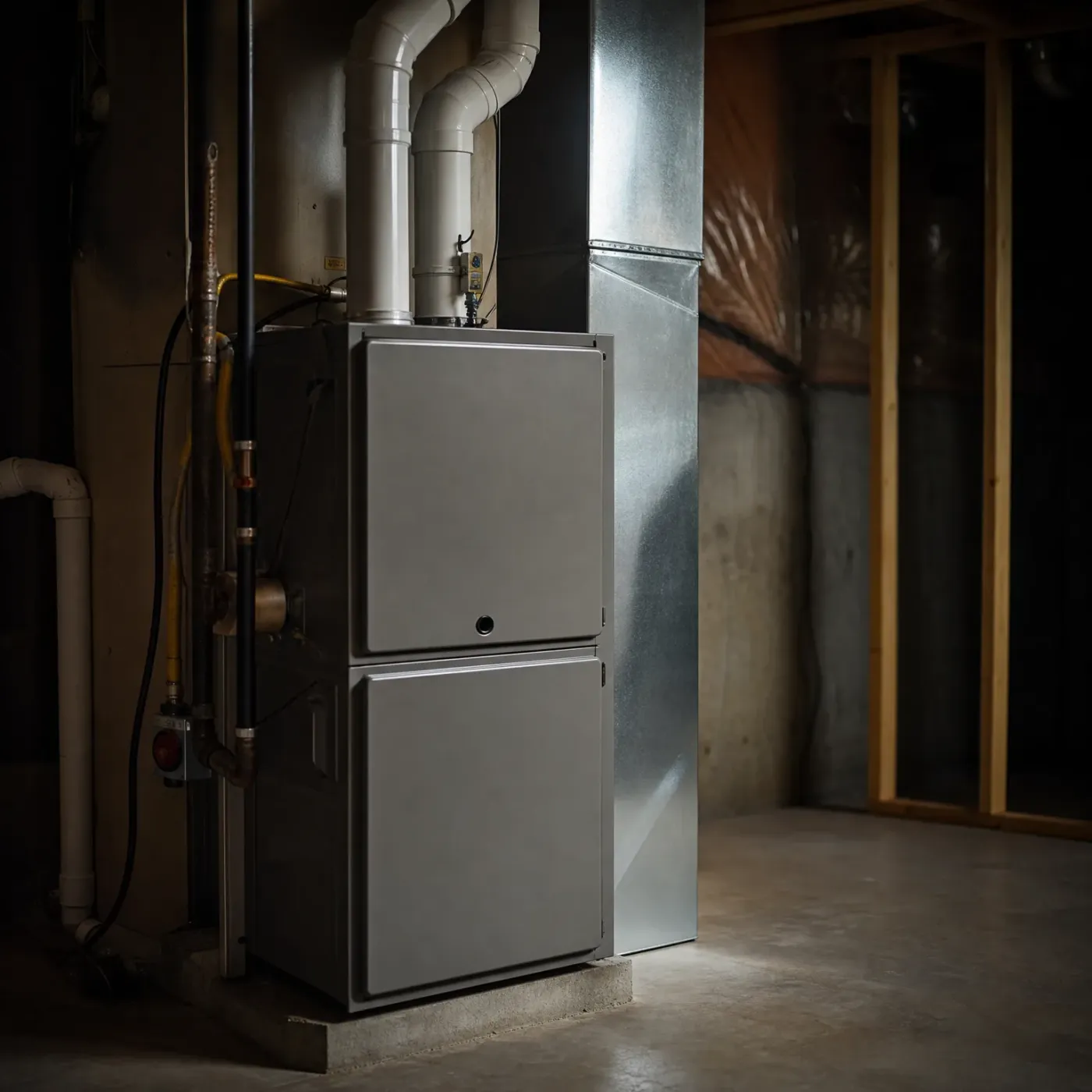






A gas furnace with two gray access panels stands on a concrete pad in a basement, with white PVC vent pipes above, sheet-metal ductwork to the right, and gas and water piping along the wall at left.

Get matched with a furnace pro in San Diego County

Furnace keeps shutting off in San Diego, CA

A furnace that shuts off before the house warms up usually means it's stopping itself on purpose. Something it checks during startup, or partway through a cycle, isn't passing, so it shuts down rather than keep running. Below are the common reasons San Diego furnaces do this and what each one points to. When you're ready, get matched with a contractor who can take a look at yours.

Connect with a pro

A furnace that shuts off a few minutes into a cycle is almost always protecting itself. A dirty flame sensor is the most common reason. It reads the flame to confirm gas is burning clean, and once it's coated with a thin layer of residue, it can't sense the flame anymore, so the control board cuts the gas rather than let it run unchecked. A clogged filter causes the same shutdown a different way. Airflow drops, heat builds up inside the furnace, and a limit switch trips to stop it from overheating. Short cycles pointing to a flame sensor or a filter are usually a quick fix. A furnace that won't stay on at all, or that shuts off and won't restart, is more likely a failing igniter or a control board that's lost confidence in the system. Since most San Diego homes heat with gas, these are the parts behind nearly every furnace that keeps shutting off here.

A gray high-efficiency furnace with white PVC venting pipes stands on blocks in a basement next to sheet-metal ductwork, with exposed wood framing on the left and a concrete wall and floor.
A furnace running a normal cycle stays lit until the thermostat is satisfied, with steady airflow through clean ductwork and no short-cycling.
An older gas furnace with two white PVC vent pipes stands on a concrete basement floor beside galvanized sheet-metal ductwork, flexible conduit, and piping along a wall.
An older furnace that shuts off early, especially with a cabinet showing age, is more likely stopping on a safety switch or a sensor going bad.

The Order Things Check

  • The flame sensor sits in the burner compartment and has to see the flame within a few seconds of ignition or the control board cuts gas to the burners.
  • A limit switch measures the air temperature inside the furnace cabinet and trips if airflow is too weak to carry heat away fast enough.
  • A dirty filter or closed vents are the usual reasons a limit switch trips, since both cut down the air moving across the heat exchanger.
  • The inducer motor has to prove it's pulling exhaust before the igniter even fires, so a failing inducer stops the cycle before flame is involved.
  • Pressure switches check for a clear vent pipe, and a blocked or disconnected vent will keep the furnace from starting a new cycle at all.
  • Each of these checks happens in order, so where in the cycle the furnace shuts off points to which part is failing.

A furnace cycle runs through a set order of checks before it decides to keep burning or shut down. First the inducer motor starts, and a pressure switch has to confirm it's actually pulling exhaust through the vent pipe before the igniter is allowed to fire. If the vent is blocked or the inducer is weak, the furnace stops right there and the burners never light. If that check passes and the burners light, the flame sensor has a few seconds to detect the flame. It's a thin metal rod sitting in the burner compartment, and it works by reading a tiny electrical signal that only flows through an active flame. A coating of residue on that rod is enough to block the signal, and the control board reads that as no flame and cuts the gas. Further into the cycle, once air is moving, a limit switch is watching the temperature inside the cabinet. Its job is making sure the heat exchanger isn't overheating because airflow can't keep up. A clogged filter or a vent that got closed in a back bedroom is usually behind that. Because these checks happen in sequence, when the shutoff happens says a lot. A furnace that never lights points to the inducer or pressure switch. One that lights and quits soon after points to the flame sensor. One that runs for a while first points to airflow and the limit switch.

Why does a furnace in San Diego County shut off so often each winter?

  • Winter nights average 41°F

    Overnight lows near 41°F mean the burner runs long enough each cycle for a dirty flame sensor or a cracked igniter to get tested, night after night.

  • Heat runs November through April

    Six months of use, November through April, is enough for dust and residue to build up on a flame sensor without anyone cleaning it in between.

  • 53.7% of homes heat with gas

    At 53.7% of homes, gas furnaces are the most common setup here, so a flame sensor or limit switch problem is the most common reason one shuts off early.

NOAA nClimDiv 1991-2020 · ACS 2020-2024

Flame sensors don't fail all at once. A thin layer builds on the rod each time the burners fire, and the signal it sends back gets weaker with every cycle.

Once that signal drops below what the control board accepts, the furnace cuts gas to the burners within seconds of lighting. That's the shutdown you're seeing, not a new problem but an old one finally crossing the line.

A smiling bearded man in a dark blue henley shirt sits leaning back on a light grey sofa in a living room, with a bowl of popcorn on a wooden coffee table and a large window behind him.
A bearded man in a dark quarter-zip sweater sits smiling on a brown sofa in a dimly lit living room, with a bowl of popcorn and a mug on a table in the foreground and a potted plant near a window behind him.
A smiling man with graying dark hair and a beard, wearing an olive sweater, sits on a sofa in a living room beside a bowl of popcorn on a wooden table.
A smiling man in a dark green henley shirt sits on a gray sofa in a living room with a lit table lamp, wooden shelving unit, and a bowl of popcorn in the foreground.

A local pro for your furnace repair

A furnace that keeps cutting out isn't going to fix itself by running less. Each cycle that ends early is another pass through whatever's tripping the safety, whether that's a flame sensor losing its signal or a limit switch catching weak airflow. Left alone, the gaps between working cycles tend to get shorter, not longer. Diagnosing which safety is tripping and why takes someone who can open the cabinet, check the flame signal, and test airflow against what the furnace expects, not a guess from the thermostat side of the wall. That's a licensed call, and San Diego's mild winters don't give you much room to put it off once a furnace is shutting off mid-cycle, since a house here with no backup heat can get cold fast on a January night with nothing running. Hand it off and let someone who works on these every week take it from here.

What you'll notice at home

The thermostat shows a call for heat, the furnace fires, and a few minutes later the house goes quiet again. You'll feel it most in the room farthest from the furnace, since that's the one that never quite catches up. If you're resetting the breaker or the furnace switch more than once in an evening to get another cycle out of it, that's the short-cycling talking, not the thermostat setting. Setting it two degrees higher won't change how long the burner stays lit.


Why it's worth fixing now

Every short cycle is the furnace trying to reach temperature and failing, which means it fires more often to make up the difference. That's more gas used to produce less heat, and more wear on the igniter and flame sensor each time they're asked to start a cycle that won't finish. A safety switch that's tripping now because of a dirty sensor can, over enough cycles, point to a cracked heat exchanger instead, which is a different repair and not one to wait on.

A woman in a cream knit sweater reclines on a beige couch with eyes closed and a slight smile, a gray hardcover book resting open on a textured blanket over her lap, with a lit table lamp and a leafy plant in the dim background.
A smiling middle-aged man in a dark green sweater sits at a candlelit table with a glass of red wine and a bowl of salad in the foreground.
A man in a dark polo shirt and cap, seen from behind, walks up a paver path toward a woman standing in the open front doorway of a single-story stucco and stone house.

Your furnace is telling you something specific

A furnace that shuts off early isn't broken in some vague way. It's tripping a safety check, over and over, for a reason that's usually one part: a flame sensor that can't read the flame anymore, or a limit switch catching weak airflow before the cabinet overheats. Six months of winter use is enough for either one to wear past what the control board will accept. That's the whole story behind the short cycles.

Knowing which part it is takes someone in front of the furnace with it running, not another night of guessing from the thermostat. A contractor who works on furnaces around San Diego County can tell you in minutes which safety is tripping and why. Once you answer a few questions about your furnace, you'll be matched with someone who takes it from there, and the work of tracking down the cause stops being yours to carry.

A gray upholstered sofa with a matching cushion sits beside a potted plant and a wooden table holding a small green plant in a stone pot, near a curtained window.
A single-story white stucco house with dark roof, stone-clad entry tower and three dark garage doors, lit from within at dusk, with a curved concrete driveway and dark mulch beds with boulders and bare young trees in the foreground under an orange and blue sunset sky.

Furnace Repair

Get the right pro for your furnace

RepairFurnace or heatingSan Diego County, CA
Step 1 of 2

What ZIP code is the job in?

  • A beige upholstered armchair with a green cushion and a knitted throw sits beside a window with a rain-speckled pane, with a lit table lamp and bookshelf behind and a wooden side table holding a ceramic mug and a book.
    • Say what's going on with your furnace, and a pro who works on them reaches out.
    • Your request goes to a San Diego County pro who takes furnace jobs.
  • A ceramic table lamp with a wide linen shade and a dark wooden bowl sit on a round wood side table beside a beige upholstered sofa with a chunky knit throw, in front of a curtained window.
    • Get the furnace repair search off your mind today.
    • Once you send the form, finding a pro is off your list.
  • A living room with a light gray sectional sofa holding brown and cream textured pillows and a knit fringed throw, a rustic wood coffee table with stacked books and a stone vase of olive branches, built-in shelves with pottery, and a tall olive tree beside a curtained window.
    • Fill out one short form instead of calling around.
    • Explain the job once and skip repeating it on every call.
  • A ceramic urn-shaped table lamp with a mottled gray glaze and beige drum shade sits on a dark wood side table beside a potted green plant, next to a light beige upholstered sofa and a framed artwork on a gray wall.
    • Your request goes to one pro, not a list of companies.
    • The pro who gets in touch is licensed in California and works in San Diego County.