





A row of single-story stucco houses with clay tile roofs behind a long concrete wall, framed by large leafy trees and trimmed hedges.

Heat Pump Installation in Chico, CA

Tell us about the job

Takes about a minute. No obligation.

New system or replacementHeat PumpButte County, CA
Step 1 of 2

What ZIP code is the job in?

Gas heats more homes in Butte County than anything else, at 45.4 percent, with electricity behind it at 35 percent. A heat pump works differently from the gas furnace most houses here already have, since it moves heat instead of burning fuel, but it still ties into the same ducts in most cases. If your house has a gas furnace now, a contractor can tell you whether your ductwork and electrical panel are ready for a heat pump or what it would take to get there. That's worth asking early, since panel capacity varies and affects what the switch involves.

6 months
November through April, your system heats
4 months
June through September, it cools
37°F
the average winter night it heats against
90°F
the average summer afternoon it cools against
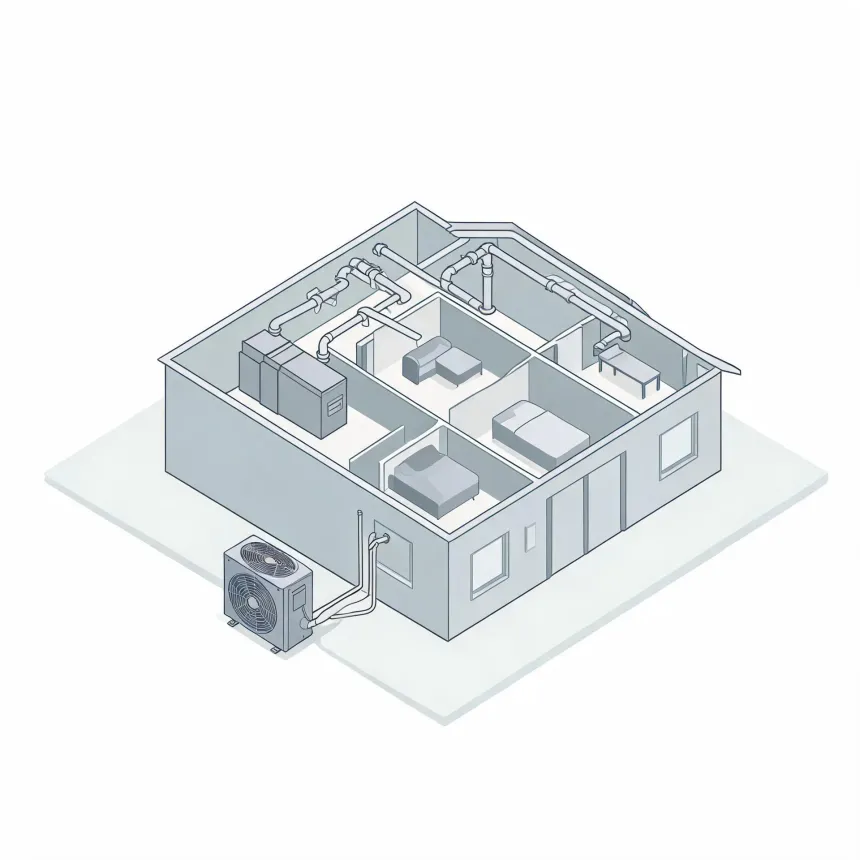
Isometric line illustration of a cutaway single-story house showing interior rooms with beds and furniture, ceiling ductwork connected to an indoor air handler, and an outdoor condenser unit linked by refrigerant lines.
Your system heats November through April and cools June through September.

NOAA nClimDiv, 1991–2020 normals

Heat here starts up in November.

Get a new heat pump in through October, so it's already running when the nights turn cold.

A standard heat pump sized right handles Chico fine

Power costs 31.97 cents a kWh statewide
38 damaging wind events from 2015 to 2024
90 winter storms from 2015 to 2024

Chico falls under zone 3B, and any heat pump installed here now has to meet federal minimums of 14.3 SEER2 for cooling and 7.5 HSPF2 for heating. Those numbers apply to equipment built from 2023 on, everywhere, not just here. That means the lowest-efficiency units aren't on the table anymore, since whatever a contractor offers you has to clear that floor already. Central air sold alongside heat pumps in this region also carries a separate rating for how it holds up on the hottest afternoons, not just over the season as a whole. None of this caps what you can install. It just sets where the floor sits.

Winters here are mild, so the heat pump doesn't have to work hard

The overnight low across December, January and February averages 37 degrees in Butte County. That's a mild load for a heat pump to meet, nothing like the deep cold other regions plan around. A standard unit sized correctly for your house can handle it without reaching for the top of the efficiency lineup.

Find a contractor
A man in a dark shirt, tan pants and a cap carries a canvas tool bag up wooden porch steps toward a blue front door, with a potted shrub beside the entry.
A white mini-split heat pump outdoor unit mounted on a concrete pad beside a gray-sided house, surrounded by gravel and green shrubs.

It runs more of the year than a furnace does, so ask about the parts that carry that load

A heat pump runs more hours over a year than the gas furnace it replaces, because it handles the cooling load too, not just the heat. That's worth asking about when you compare systems, even where winters stay mild. Ask what the unit sounds like at low stage, since a heat pump spends most of its time running at partial capacity rather than cycling on and off the way a furnace does. Ask about the outdoor unit's defrost cycle, since every heat pump clears frost off the outdoor coil now and then in cold, damp weather. How often that happens matters more than whether it happens at all. Ask what the compressor and fan motor are rated for, since a system running most days of the year wears on different parts than one that only fires up a few months a season. None of that means the equipment has to be oversized or high-end. It means the parts doing the daily work are worth asking about directly, not just the number on the spec sheet.

The outdoor unit and the ductwork decide the bid

A heat pump has to move more air over the course of a year than a furnace does, since it handles both heating and cooling. If the existing ducts are undersized or leaky, a contractor may need to modify or seal them before the new system can perform the way it's rated to. That work costs more than swapping one box for another, and it's usually the biggest variable between one quote and the next.
Capacity has to match the house, not the budget

An oversized heat pump cycles on and off instead of running steady at low stage, which wears on the compressor and leaves rooms uneven. An undersized one runs flat out and leans on backup heat more than it should. Sizing that correctly takes a load calculation on the house itself, not a guess based on the old system's size, and that calculation is part of what the installation price is paying for.

That SEER2 and HSPF2 pair on the label is a ratio, not a guarantee. It compares the heat moved against the power it takes to move it, tested under set conditions in a lab. Your actual results depend on duct condition, how the system's sized for the house and how it's installed, so homes running the same rated unit can still see different results on the utility bill. A higher rating usually means a variable-speed compressor that spends most of its time running gently at partial output instead of slamming on and off, which is also why those units tend to run quieter. The rating doesn't tell you how the system handles the coldest morning of the year or whether backup heat kicks in more than it should. Ask the contractor to walk through what the number means for the specific equipment being proposed, not just the figure on the spec sheet.

Installation day starts with the old equipment coming out, not the new one going in. The indoor coil and outdoor unit both get disconnected, and if the furnace is going too, that comes out at the same time since the heat pump's air handler takes its place. Refrigerant lines get run or reused depending on whether the old system used the same line set, and that line set has to be rated for the refrigerant the new unit uses, which isn't always the same as what came out. The electrical side usually takes as long as the mechanical side, since a heat pump draws power the old gas furnace never did and the circuit has to be sized for it. Once everything's connected, the system gets charged with refrigerant and run through a startup check, airflow at the vents, temperature split across the coil, and the controls talking to the thermostat correctly before anyone calls the job done.