A lit craftsman house with glowing windows on a rainy night, surrounded by tall evergreen trees and a wet reflective street.

Heat Pump Installation in Eureka, CA

Tell us about the job

Takes about a minute. No obligation.

New system or replacementHeat PumpHumboldt County, CA
Step 1 of 2

What ZIP code is the job in?

Electricity here runs 38.43 cents a kilowatt-hour

That is higher than almost anywhere else in the country. A heat pump moves heat instead of burning gas to make it, which normally works in its favor, but every kilowatt it draws costs more here than it would most places. How that machine performs on a given day matters more here than in a cheaper state.

A poorly matched system costs you on every hour it runs

Humboldt summers stay mild, dew points average 53 degrees in June, July and August, so this isn't a climate pushing equipment hard for months at a stretch. The cost shows up per hour of runtime, not from long stretches of heavy use. A unit sized or installed wrong still burns expensive power each time it kicks on.

8 months
October through May, your system heats
37°F
the average winter night it heats against
79°F
the average summer afternoon it cools against
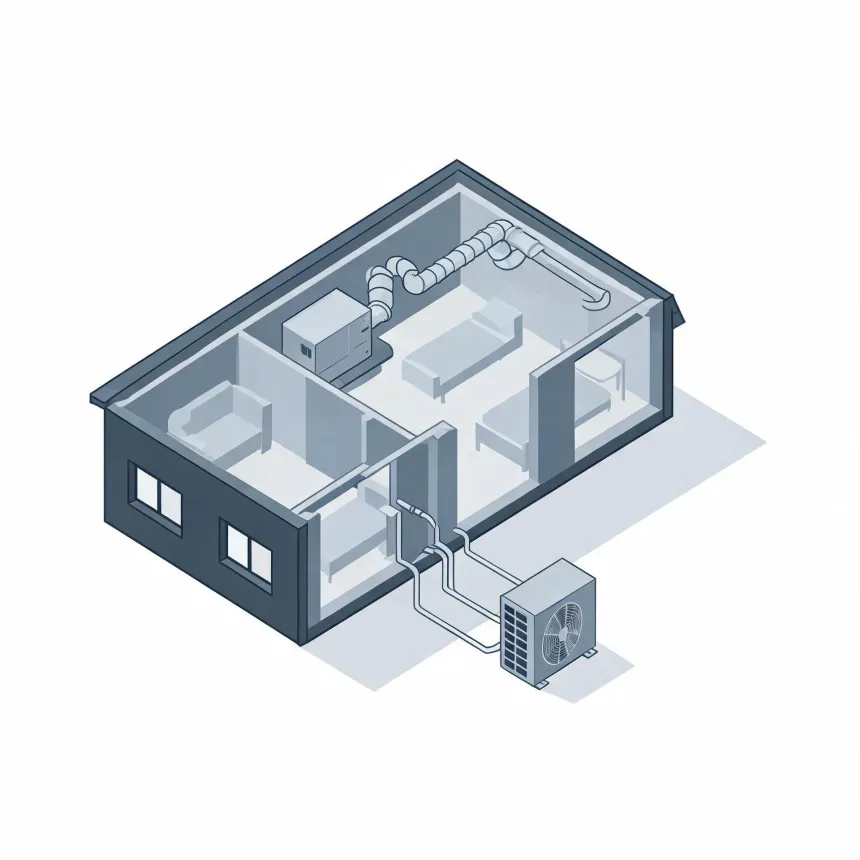
Isometric cutaway illustration of a small house showing interior rooms with furniture, an indoor air handler with flexible ducting, and refrigerant lines running to an outdoor condenser unit beside the building.

Humboldt County logged 282 severe weather events between 2015 and 2024, most of them wind and winter storms.

An outdoor heat pump unit sits outside through all of it, so where it goes and how it's protected is part of the installation.

Eight months of heat is a long time to run on a bad install

Heat runs October through May
145 damaging wind events from 2015 to 2024
21 hail events from 2015 to 2024
Most Homes Here Run on GasGas heats 55.5% of homes here, more than any other fuel.

Humboldt County falls under zone 4C in the 2021 energy code, a mixed climate that asks real work of both heating and cooling. Any split-system heat pump installed here has to clear federal minimums built for that kind of demand: at least 14.3 Btu of heat moved per watt-hour of electricity over summer, at least 7.5 over winter. Those numbers set a floor. A contractor can install above it, but not below. If the system qualifies, a federal tax credit is available toward the cost. Given what power costs here, the minimum is a starting point worth asking about, not the whole conversation.

Get the install right, and it pays you back on every bill

Ask what efficiency level the install is actually hitting, not just whether it clears the federal minimum. Power here costs more than almost anywhere else, so a system installed a notch above the floor earns that difference back on every hour it runs. That's a question worth settling before the unit goes in, not after the first bill.

Find a contractor
A man seen from behind in a gray shirt and tan work pants climbs porch steps toward a blue front door, carrying a worn leather tool bag in his right hand, with a potted shrub in a blue planter beside the door.
A gray heat pump condenser unit mounted on a concrete pad against the gray lap-siding exterior wall of a house.

An Older House

Half the homes in Humboldt County were built in 1973 or earlier. A house that age has usually had its heating system replaced at least once already, and the ductwork or electrical panel may still date back further than that. A heat pump install has to work with what's actually in the house, not what the house was built with. That means checking the ductwork it would tie into, whether the panel can take the new load, and where the outdoor unit and air handler can go. None of that is a given the way it would be on new construction. Worth having a contractor look at what's there before assuming the old setup is a clean fit for the new one.

Sizing Sets the Price

A contractor has to run a load calculation on the house, room by room, before pricing the equipment. Get that number wrong and the quote is wrong too. A unit too big cycles on and off instead of running steady, which wears the compressor and never gets the chance to run efficiently. A unit too small runs constantly and still can't keep up on the coldest or hottest days. Either mistake costs more to fix after the fact than the calculation would have cost up front.

What's Already There Changes the Job

If the ductwork is already in place and sized right, a lot of the labor is just swapping equipment. If the ducts are undersized, leaky, or routed wrong for a heat pump's airflow needs, that work gets added to the job before the new system can perform the way it's rated to. The electrical panel matters too. An outdoor compressor and an air handler both draw power, and if the panel can't take the new circuit, that's another piece of work the installer has to account for before the heat pump goes in.

When you get quotes side by side, ask each contractor what rating the proposed system actually hits, not just the model number. The same equipment can be installed to perform differently depending on how the refrigerant lines are run, how well the indoor and outdoor units are matched, and how the ductwork feeds it. Ask who manufactures the compressor and whether parts and labor are covered separately, since those warranties often run different lengths. Ask how sound is handled too. An outdoor unit running most of the day is something you'll hear from a patio or a bedroom window, and placement affects that as much as the equipment does. A quote that only lists a price and a model number is leaving out the parts of the job that decide how well it runs once it's in.

Where the outdoor unit goes matters as much as how short the line set is. A low wall or fence break on the windward side keeps wind-driven debris off the coil without blocking the airflow it needs. Winter storms hit this county 115 times between 2015 and 2024, and damaging wind separately hit it 145 times in that same stretch, so this isn't a once-in-a-while risk to plan around. A heat pump needs power to run, for heat as well as cooling, so an outage takes both away at once unless there's a backup plan in place. Ask the contractor about a disconnect and surge protection at install, and whether the system comes back on by itself once power returns.