





White stucco houses with red tile roofs illuminated by warm outdoor lighting at the base of a hillside at dusk.

Heat Pump Installation in Marysville, CA

Tell us about the job

Takes about a minute. No obligation.

New system or replacementHeat PumpYuba County, CA
Step 1 of 2

What ZIP code is the job in?

Yuba County recorded 295 severe weather events between 2015 and 2024. Most of that was winter storms, 239 of them, with damaging wind hitting 54 times. Hail and tornadoes are rare here, one of each in that span. Across California, 17% of households lost power for a day or more in 2024. A heat pump sits outside, so where it goes and what shelters it matters. When the power goes out, it stops, same as a gas furnace's blower would.

6 months
November through April, your system heats
5 months
May through September, it cools
38°F
the average winter night it heats against
91°F
the average summer afternoon it cools against
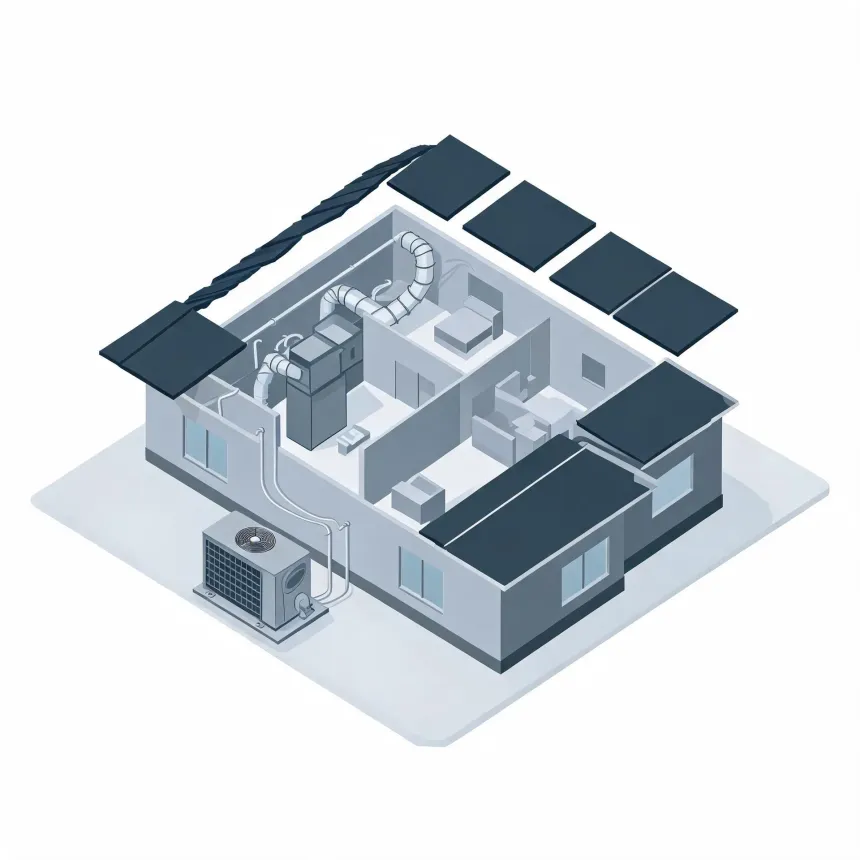
Isometric grayscale illustration of a cutaway single-story house showing interior rooms, ductwork and an air handler, an exterior condenser unit connected by lines, and dark solar panels on the roof.
Your system heats November through April and cools May through September.

NOAA nClimDiv, 1991–2020 normals

Electricity in Yuba County averages 38.55 cents per kilowatt-hour, among the highest rates in the country.

A heat pump that runs inefficiently costs more here on every hour it operates, not just over a long season.

Nearly half this county heats with gas, and the grid here doesn't always hold up

48.3% of homes heat with gas
54 damaging wind events from 2015 to 2024
239 winter storms from 2015 to 2024
Time it for NovemberHeat runs here from November through April, six months of the year.

Yuba County falls under climate zone 3B, and any heat pump installed here has to meet the federal minimum for that zone. For cooling, that means pulling at least 14.3 Btu of heat for every watt-hour of electricity used over the summer. For heating, at least 7.5 Btu per watt-hour over the winter. Central air systems installed in this region face a separate efficiency floor on top of that, tied to the unit's EER2 rating, which measures how it holds up under steady heat rather than over a full season. These numbers set the floor, not the ceiling. A contractor sizing a system for this county has to start from what the region requires, then weigh that against what the house actually needs to stay comfortable through a long, dry summer.

Plan the install around the power going out

Where the outdoor unit goes and what shelters it from wind matters here. So does a backup plan for heat and hot water when the power drops, since a heat pump stops in an outage same as a gas furnace's blower does. Both are decisions for the install, not after.

Find a contractor
A person in a dark long-sleeved shirt and tan pants, seen from behind, carries a worn canvas tool bag up stone steps toward a blue front door with a shrub in a blue planter beside it.
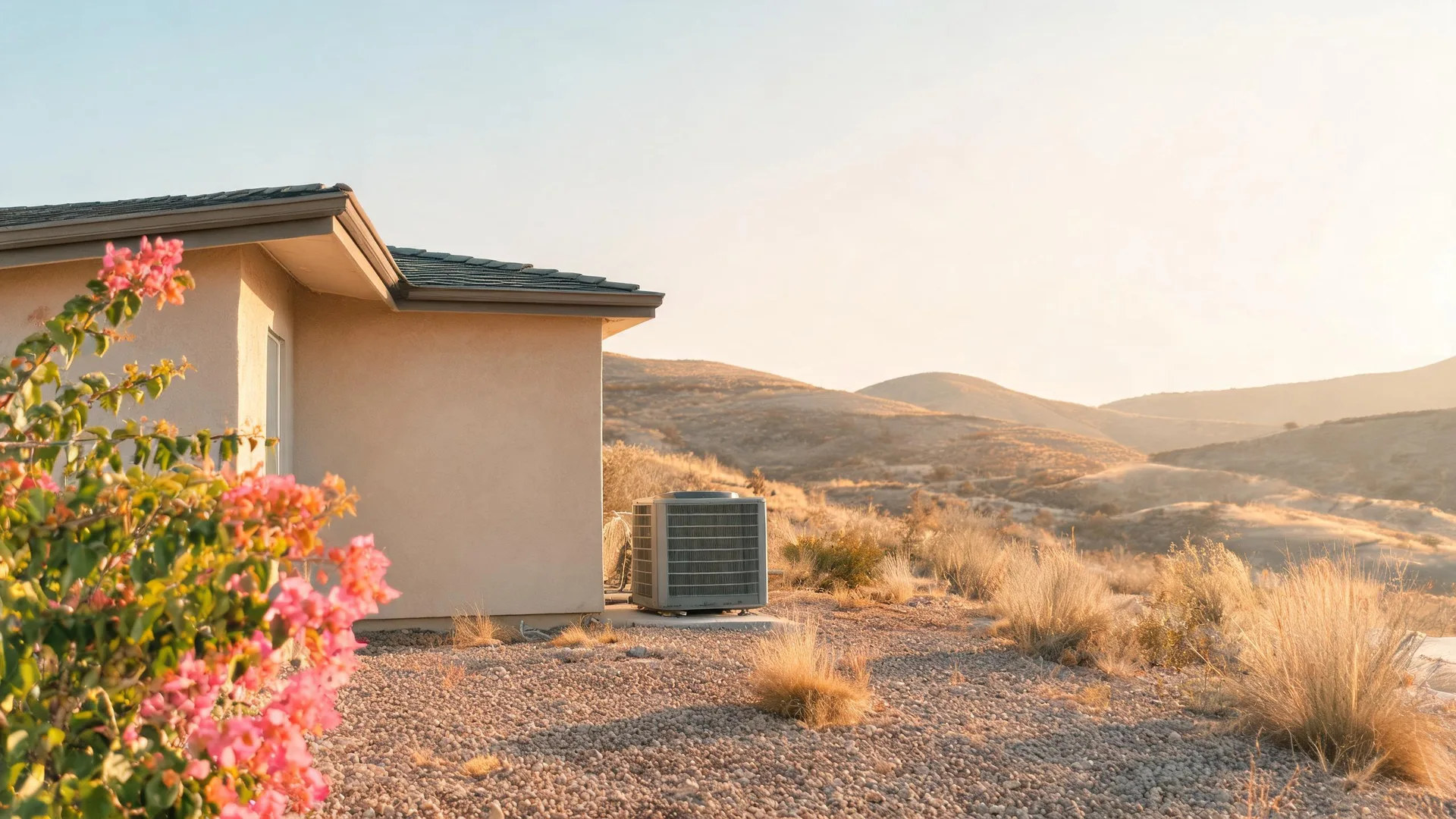
A white mini-split heat pump outdoor unit mounted on a concrete pad beside a gray-sided house, surrounded by gravel and green shrubs.

What that number actually promises

That SEER2 and HSPF2 number on the label is a lab result, not a promise. It's measured over a full range of conditions, mild days and extreme ones averaged together, so the rating tells you how the system performs across a whole season, not on any single afternoon. A unit can carry a high rating and still struggle on the hottest or coldest days, because those days pull the system away from the conditions where it runs best. The rating also assumes correct sizing and a clean installation. Oversize the unit or shortchange the ductwork and refrigerant charge, and the real efficiency drops below what the label promises, no matter how high that number is. A dirty filter or a coil caked with dust has the same effect: the machine works harder to move the same heat, and every hour it runs costs more than the rating suggests. Two systems with identical labels can perform differently in the same house depending on how well they were installed and how well they're kept up afterward. The number on the label is a starting point for comparing equipment, not a guarantee of what you'll see on your utility bill.

A heat pump sized wrong never runs right

An oversized heat pump blasts the house to temperature and shuts off before it finishes pulling moisture out of the air, so the house feels clammy even at the right number on the thermostat. It also cycles on and off more, and every start draws a hard pull on the compressor. An undersized one never catches up at all. It runs flat out on the hottest and coldest days and still falls short, and the extra strain wears on the compressor faster than if it had been built for the load from the start.
Sizing is a room by room calculation, not a swap

A contractor works out the size using a load calculation that accounts for the square footage, the insulation, the windows, and how much shade the house gets, not just the size of the system already in place. A furnace or old heat pump sized years ago may not match what the house actually needs now, especially if anything in the building envelope changed since. Getting this right matters more with a heat pump than with a gas furnace, because the heat pump also has to be sized for cooling capacity, and the equipment that handles both jobs well is a narrower match than most people expect.

That rate difference is the reason to look past the price tag on the quote. Two systems can meet the same zone 3B minimum and still cost different amounts to run, because one holds its efficiency better once it's installed. Ask a contractor to show the SEER2 and HSPF2 numbers for each unit being considered, not just for the one they're recommending. A lower price up front doesn't tell you what the compressor will cost to run every hour it's on. Nothing stops a homeowner here from asking for better than the floor the zone requires.

Install day starts with the old equipment coming out, if there is any, and the line set and electrical getting checked before anything new goes in. The outdoor unit gets set on a pad or bracket, leveled, and connected to the indoor coil through a refrigerant line. That line gets evacuated with a vacuum pump before the refrigerant goes in, which pulls out moisture and air that would otherwise wreck the system's efficiency from day one. The electrical connection gets sized to the unit, since a heat pump pulls more current than the thermostat alone can tell you. Once it's running, the charge gets checked against the manufacturer's specs, not just topped off by feel. A contractor should also walk the house with you afterward and show you the shutoffs, the breaker, and what the thermostat's going to do differently than whatever heated the house before.