A single-story stucco house with a tile roof seen beneath large overhanging oak branches, with a lawn and blurred agave and grasses in the foreground.

Furnace Maintenance in Madera, CA

Tell us about the job

Takes about a minute. No obligation.

Tune-up, service, or cleaningFurnace or heatingMadera County, CA
Step 1 of 2

What ZIP code is the job in?

Weather here takes a toll

Madera County recorded 282 severe weather events between 2015 and 2024, including 185 winter storms and 88 damaging wind events. That kind of weather wears on a furnace, especially anything mounted outside or exposed to the attic and roof vents.


Power doesn't always hold

In 2024, 17% of California households went at least 24 hours without power. A furnace that was already struggling before an outage is the one that won't restart when the power comes back on.

Gas heats more homes in Madera County than electricity or propane combined with it.

A gas furnace needs its burner, venting and safety controls checked every year, not just a new filter.

Half the homes here were built by 1988, young enough that a yearly check is what keeps a furnace reliable instead of what you do once it stops being

Half the homes here were built by 1988
Climate zone 3B
Heat runs October through May

Furnaces here run from October through May, eight months out of twelve. October is when the system has to work the first time, not when it's convenient to find out it doesn't. Book the tune-up in September. A tech checking the burner and safety controls in September catches a cracked heat exchanger or a weak igniter before the first cold night asks the furnace to prove itself. Wait until October and you're calling after it's already failed to start, which is a different job and a colder house while you wait for it.

Have the furnace checked before the next storm tests it

A furnace that sits through 185 winter storms and 88 damaging wind events a year takes some wear, even when nothing looks wrong. Get the burner, venting and safety controls checked before the next one hits, so a power cut or a bad night isn't when you find out something needed fixing.

Find a contractor
A man in a dark jacket, cap and tan work pants climbs steps toward a blue front door, carrying a canvas tool bag with tools in its side pockets, beside a shrub in a blue planter.
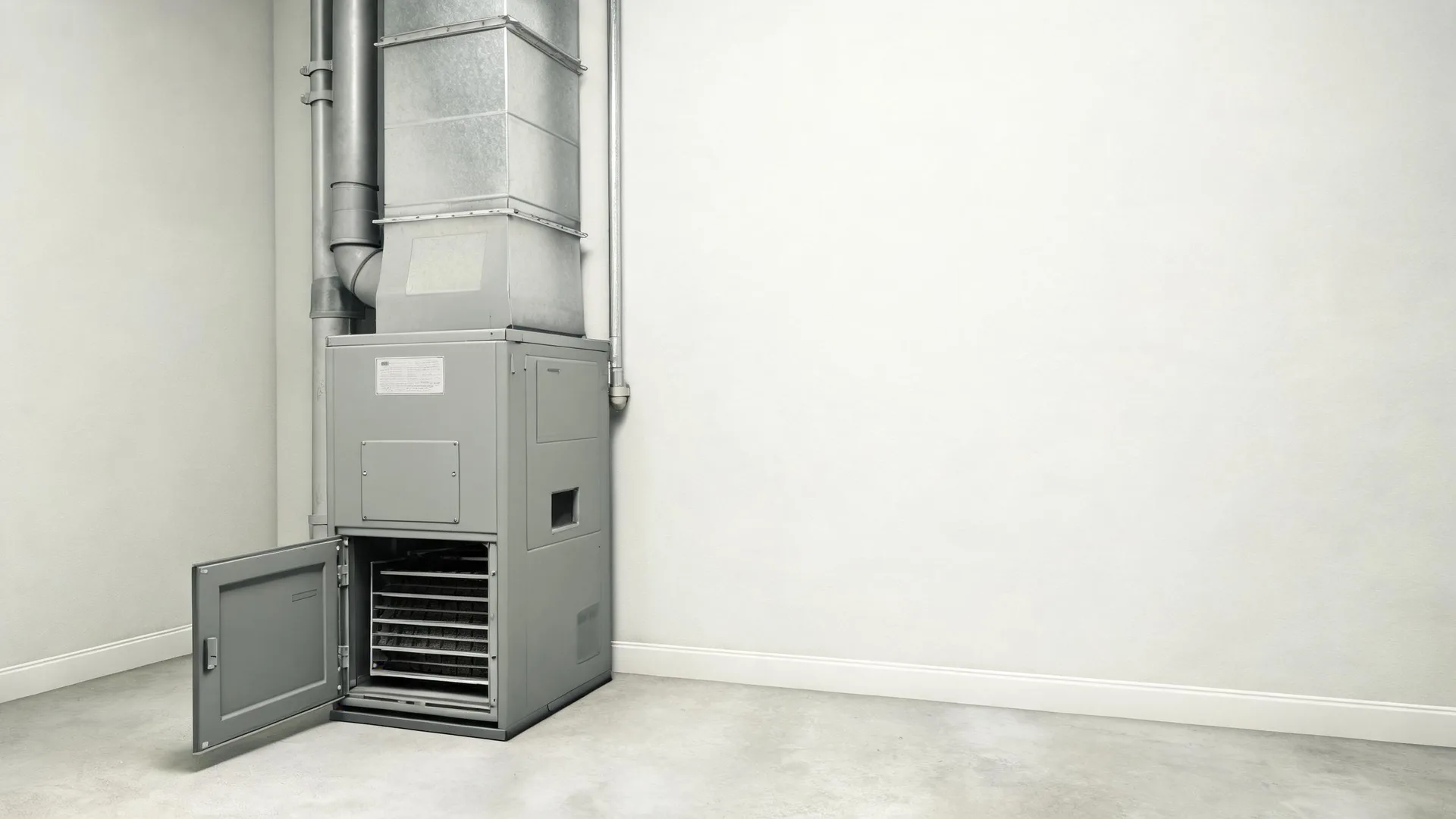
A gas furnace with attached ductwork, gas piping, and condensate lines installed in a concrete-block basement.

Eight Months a Year Is a Long Shift for a Furnace

Eight months of heat a year is a long stretch for one machine to carry. The furnace starts in October and doesn't get a break until May, running through whatever the winter brings, storm after storm. That kind of run time wears on the burner and the igniter faster than a shorter season would. A furnace in a place that only heats for a couple months can hide a weak part for years. One running eight months a year doesn't get that luxury.

A dirty filter works the whole furnace harder

Air has to pass through the filter before it reaches the blower and the heat exchanger. A filter clogged with dust makes the blower pull harder to move the same air, and that strain carries right through to the motor. Less airflow across the heat exchanger also means it runs hotter than it should, which is what cracks one over time.

The drain and the coil cause different problems than the filter

A high efficiency furnace produces condensation that has to leave through a drain line, and if that line clogs, the furnace can shut itself down or leak water near the unit. A dirty coil in the cooling side of the system restricts airflow the same way a clogged filter does, so a tech checking one should look at the other. Each part fails on its own schedule, which is why a yearly check covers all three instead of just the filter.

A furnace usually tells you before it quits outright. It might take two or three tries to light instead of catching right away. The flame behind the burner window should burn steady and blue, so a flicker or a yellow tinge is worth a second look. Some furnaces start making a new noise, a rattle on startup or a hum that wasn't there before, and that's often a blower wheel or a motor bearing asking for attention. A burning smell the first few times you run it each season is normal as dust clears off, but a smell that lingers past the first couple of cycles isn't. If the air coming out of the vents feels weaker than it used to, something upstream of the blower is restricting it. None of these mean the furnace is about to fail tonight, but they're the kind of thing a tech checking the burner and controls will catch before they turn into a no-heat call.

A furnace that runs eight months straight doesn't get much downtime to reveal a weak part on its own. It just keeps going until something gives out. The burner and igniter take the brunt of that run time, and by the time a winter storm is testing the system, a worn part has had months to get worse. A yearly check catches that wear while it's still a small fix, not a cold house during the next outage. That's the point of having it looked at before the season leans on it again.