November starts the load
Heat goes on in November here and keeps running through May. That's seven months of the furnace carrying the house, with no break in between to catch a problem early.
Takes about a minute. No obligation.
Heat goes on in November here and keeps running through May. That's seven months of the furnace carrying the house, with no break in between to catch a problem early.
Book the check in October, before the first cold call on the furnace. A technician can catch a weak igniter or a cracked heat exchanger while the furnace is still idle, not after it's already working every day.
Salinas nights average 38°F in the dead of winter, nothing like the hard freezes furnaces fight further inland.
A furnace built for real strain barely notices mild duty, so a yearly check usually finds a furnace in good shape, not one fighting to keep up.



Utility gas heats 47.8% of homes in Monterey County, more than any other fuel, with electricity close behind at 42.6%. That split matters for a maintenance visit. A gas furnace has a burner, a flue, and a gas valve, and a filter change doesn't tell a technician anything about those. The check is whether the burner lights clean, whether the flue is drafting exhaust out instead of letting it spill back into the house, and whether the gas valve and pressure switch are doing what they're supposed to. None of that is wear from a hard winter. It's just what a gas furnace needs looked at once a year, mild season or not.
Half the homes in Monterey County were built in 1976 or earlier, half in 1976 or later. Old or new, a furnace still needs the same yearly look at the burner, the flue and the gas valve. Age doesn't change that. One visit a year covers it.
Find a contractorA quick visit gets the filter changed and the thermostat checked, and that's about it. A thorough one opens the cabinet. The technician pulls the burners and looks at the flame, not just whether it lights but what color it burns and whether it reaches evenly across. They check the flue for a solid connection and real draft, since a cracked or loose section can let exhaust drift where it shouldn't. They test the gas pressure at the valve, because too high or too low both cause problems that show up as a breakdown later. They check the igniter for hairline cracks and the flame sensor for corrosion, since both fail slow and then fail all at once. A short visit skips all of that and still runs the furnace for a minute to prove it turns on. A long one proves it runs right.
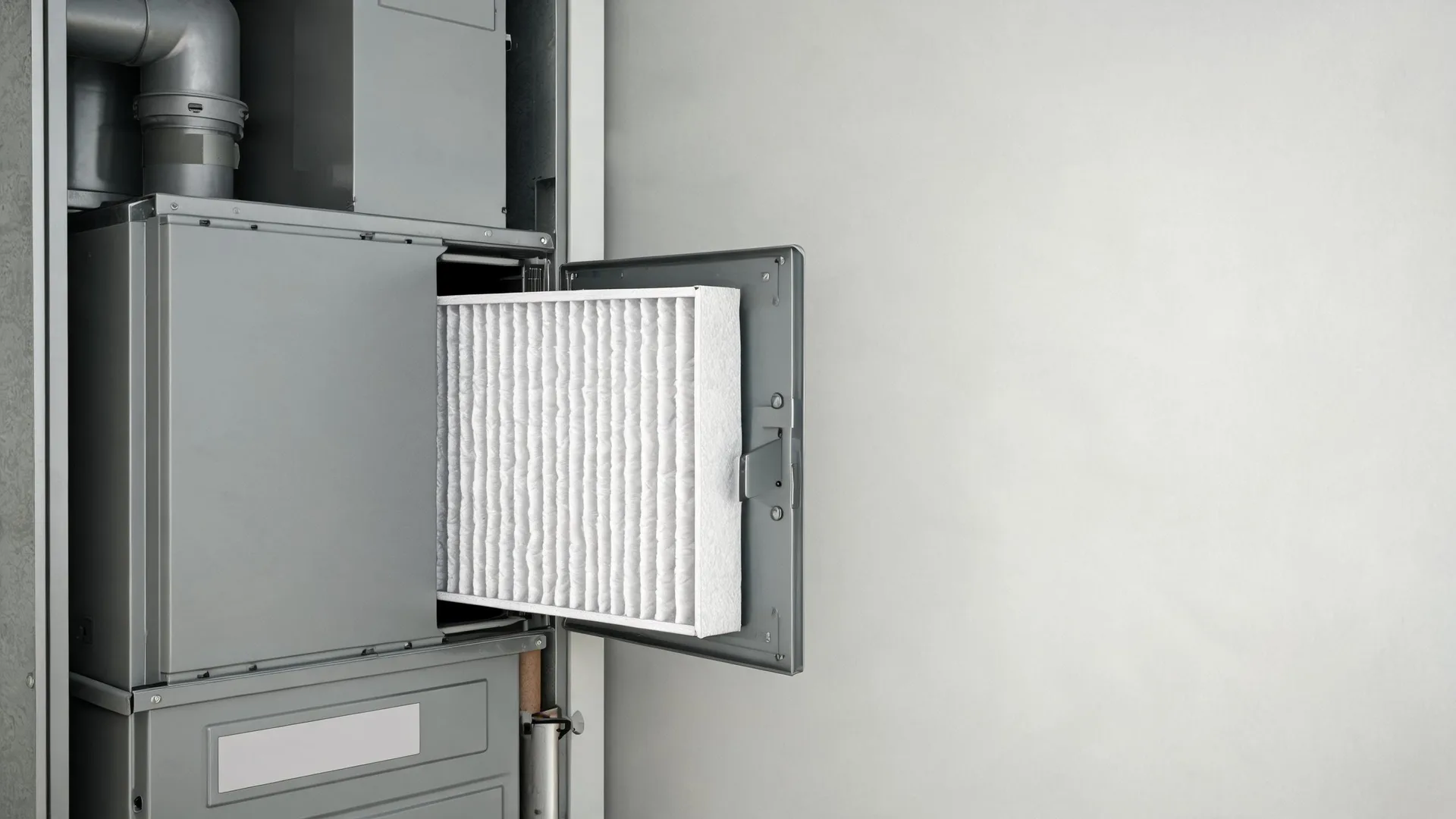
A dirty filter chokes airflow across the heat exchanger, and that makes the furnace run longer to do the same job. Check it every month it's running and hold it up to the light. If you can't see light through it, swap it. This is the one job that's actually yours between visits.
A burner flame that's yellow or flickering instead of steady blue means something's off and it's not a do-it-yourself fix. Same with a burning smell that doesn't clear after the first few minutes of a cold start, or a furnace that short-cycles, turning on and off every few minutes instead of running a full stretch. Any of those, shut it down and get a technician out rather than waiting for the next scheduled check.
Furnaces don't have a coil or a drain line, that's the air conditioner side of the system. What a furnace has is a filter, and it does more work than people think. Air has to pass across the heat exchanger to pick up heat before it moves through the house, and the filter sits right in that path. Block it with dust and the furnace pulls harder to move the same air, which runs the blower longer and runs the heat exchanger hotter than it's built for. That heat has to go somewhere, and over time it stresses the metal until it cracks. A cracked heat exchanger is the one failure that isn't just inconvenient, since it's the part keeping exhaust out of the air you breathe. None of that starts with the burner or the gas valve. It starts with a filter nobody changed.
A tune-up is more than a visual check. The technician checks the blower motor and wheel, since a wobble or a bearing starting to go will shorten its life fast once the furnace is running every day. They check the limit switch, which shuts the burner off if the furnace overheats, because a switch that's failed won't catch that the next time it matters. They check the capacitor on the blower motor too, since a weak one makes the motor strain to start and run. Wiring connections get checked and tightened, since a loose connection at a gas furnace's control board can cause intermittent faults that look like something else entirely. None of this shows up from outside the cabinet. It only shows up when someone opens it up and tests each part on purpose.