

An unfinished basement featuring exposed ceiling joists, a metal HVAC unit with round ductwork, a hanging light bulb, and scattered boxes and debris along the left wall.

Furnace Repair in Madera, CA

Tell us about the job

Takes about a minute. No obligation.

RepairFurnace or heatingMadera County, CA
Step 1 of 2

What ZIP code is the job in?

Madera County saw 282 severe weather events between 2015 and 2024. Winter storms made up most of that, 185 of them, with damaging wind hitting the county 88 times on top of that. Hail is rarer here but it happens, six events in that stretch, and three tornadoes touched down too. A furnace shares the property with the outdoor condenser, and wind-driven debris or hail doesn't wait for summer to show up. Statewide, 17% of California households went at least a day without power in 2024. If a storm came through recently, or the power was out for a while, it's worth having the furnace checked even if it still runs.

8 months
October through May, your furnace is on duty
33°F
the average winter night it heats against
185 winter storms
in ten years, the nights a failure hurts most
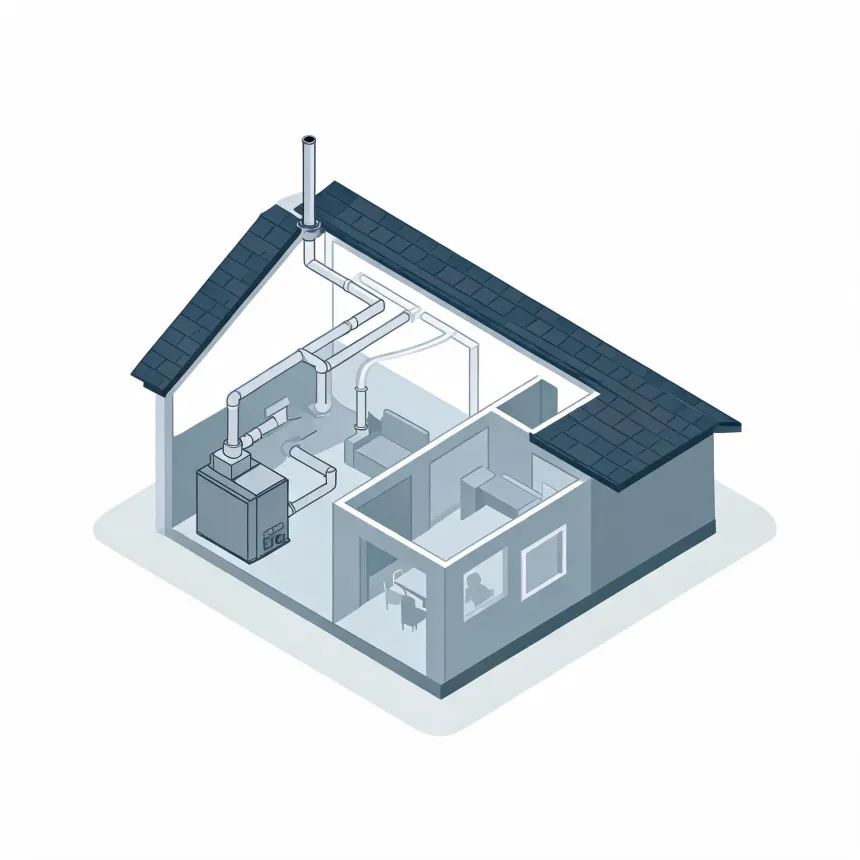
Isometric cutaway illustration of a single-story house showing interior rooms, a furnace unit with connected ductwork, and a flue pipe extending through the dark shingled roof.
Your furnace works hardest from November through April.

NOAA nClimDiv, 1991–2020 normals

Furnaces in Madera County start working in October, after sitting idle since spring.

A weak part usually waits for that first cold stretch to fail.

Half the homes here were built in 1988 or later, and that furnace hasn't earned retirement yet

Half the homes here were built by 1988
Heat runs October through May
Winter nights average 33°F

Furnaces here run from October through May, eight months out of twelve. That's a long stretch for a burner and blower to carry, even in a furnace that's still well within its years. The parts that wear, the igniter, the flame sensor, the blower motor, wear in proportion to how much they run, not how old the unit is. A furnace that only had to cover a few cold snaps would get long stretches to sit idle and cool down. This one doesn't get that break. When something in it is already weak, that long runtime is usually what brings it to the surface, and a technician can find it rather than guess at it.

After a storm, get the furnace looked at too

If hail or wind came through recently, have the furnace checked along with the outdoor unit, even if it's still heating fine. A tech can catch what the storm did before it turns into a bigger repair.

Find a contractor
A gas furnace with attached ductwork, gas piping, and condensate lines installed in a concrete-block basement.

Built in 1988 or later, it's got years left in it

A furnace that came with a newer house still has most of its working life ahead of it. That points toward repair over replacement when something goes wrong, and it's worth telling the technician roughly when the system was installed if you know it. If it came with the house, that's one more reason to get the specific part fixed rather than talk yourself into a new unit.

A small problem rarely stays small

A cracked heat exchanger, a flickering igniter, a flame sensor coated in residue, none of these fix themselves by running longer. Heat and vibration work on a weak part every cycle the furnace fires. What starts as a short cycle or a delayed ignition can turn into a cracked component or a blower motor that seizes, and the furnace that still limps along today can quit outright on the next cold morning.

Running it anyway costs more than the repair

A furnace that's struggling, short cycling, tripping its limit switch, straining to reach temperature, is usually pulling more gas or electricity to do less heating. Left alone, a cheap part failure can take a more expensive part down with it, like a cracked igniter that eventually damages the control board reading it. Calling someone when the trouble first shows up almost always means fixing less than waiting does.

An unfinished basement featuring concrete block walls, exposed floor joists, and a metal forced-air furnace with ductwork near a central pillar.

A new furnace would cut about $90 a year off heating for a typical Madera County home.

  • A new high-efficiency furnace$420 a year
  • An older furnace$510 a year

Estimates for a typical Madera County home, compared with an older unit built to the previous federal minimum, from EIA household energy data, California fuel prices and NOAA climate normals. Your home will differ.

Repair makes sense when one part has failed and the heat exchanger is sound.

Replacement makes sense when the heat exchanger is cracked or the furnace keeps needing parts.

When a furnace breaks, the question is whether the trouble is in one part or in the system as a whole. A failed igniter, a bad flame sensor, a blown capacitor, these are single parts doing a single job, and replacing one brings the whole unit back to normal. A cracked heat exchanger is different. That's the part that separates the flame from the air moving through your house, and once it's split, the furnace isn't safe to run regardless of what else still works. Age matters less than which kind of failure you're looking at. An older furnace with a bad blower motor is usually worth repairing. A furnace with a cracked heat exchanger is not, no matter how new the rest of it looks. A technician can tell you which one you're dealing with, and that answer matters more than how long the unit has been in service.