







White stucco houses with red tile roofs illuminated by warm outdoor lighting at the base of a hillside at dusk.

Heat Pump Installation in Santa Maria, CA

Tell us about the job

Takes about a minute. No obligation.

New system or replacementHeat PumpSanta Barbara County, CA
Step 1 of 2

What ZIP code is the job in?

Most houses in Santa Barbara County run on utility gas, close to seven in ten. Electricity comes in second at under a quarter, and a small slice run on bottled or LP gas. A heat pump installed here usually means going electric for the first time, not swapping one electric system for another. That changes the job. The contractor needs to check what the electrical panel can carry, since a gas furnace never asked much of it and a heat pump will. If your home has gas lines run for a furnace or water heater, those stay in the walls whether or not the new system uses them.

7 months
November through May, your system heats
3 months
July through September, it cools
40°F
the average winter night it heats against
81°F
the average summer afternoon it cools against
Isometric grayscale illustration of a cutaway single-story house showing interior rooms, ductwork and an air handler, an exterior condenser unit connected by lines, and dark solar panels on the roof.
Your system heats November through May and cools July through September.

NOAA nClimDiv, 1991–2020 normals

Half the homes in Santa Barbara County were built in 1974 or earlier, half in 1974 or later.

A heat pump sized right for a standard Santa Maria home works in either one, no special equipment required.

Mild winters mean a heat pump here doesn't have to work hard to keep up

32 damaging wind events from 2015 to 2024
3 winter storms from 2015 to 2024
Winter nights average 40°F
Put it in before NovemberHeat runs November through May here, about seven months. October is the month to get it done.

Santa Maria sits in climate zone 3C, warm with a long run of cooling months and a winter mild enough you barely notice it. Any heat pump installed here new has to meet federal minimums for this kind of equipment. That's 14.3 SEER2 for cooling, 7.5 HSPF2 for heating. A straight central air conditioner, no heat pump, faces its own cooling-only number, also 14.3 SEER2, plus a separate EER2 requirement that depends on which SEER2 tier the unit is certified under. These are floors. A licensed contractor isn't going to offer you anything below them. A system built for this zone doesn't have to do much heating, but it runs cooling from spring well into fall, and the rating on the unit is what tells you it can keep up.

The right size for this home, nothing more

A heat pump sized to a standard Santa Maria home doesn't need to be bigger or pricier than that to keep up here. California runs 31.97 cents per kilowatt-hour, among the higher electricity rates in the country, so a system rated at the federal minimum and sized correctly is the one that keeps your bill in check.

Find a contractor
A man in a cap, dark long-sleeve shirt, tan work pants and boots walks up wooden porch steps toward a teal front door, carrying a canvas tool bag with hand tools.
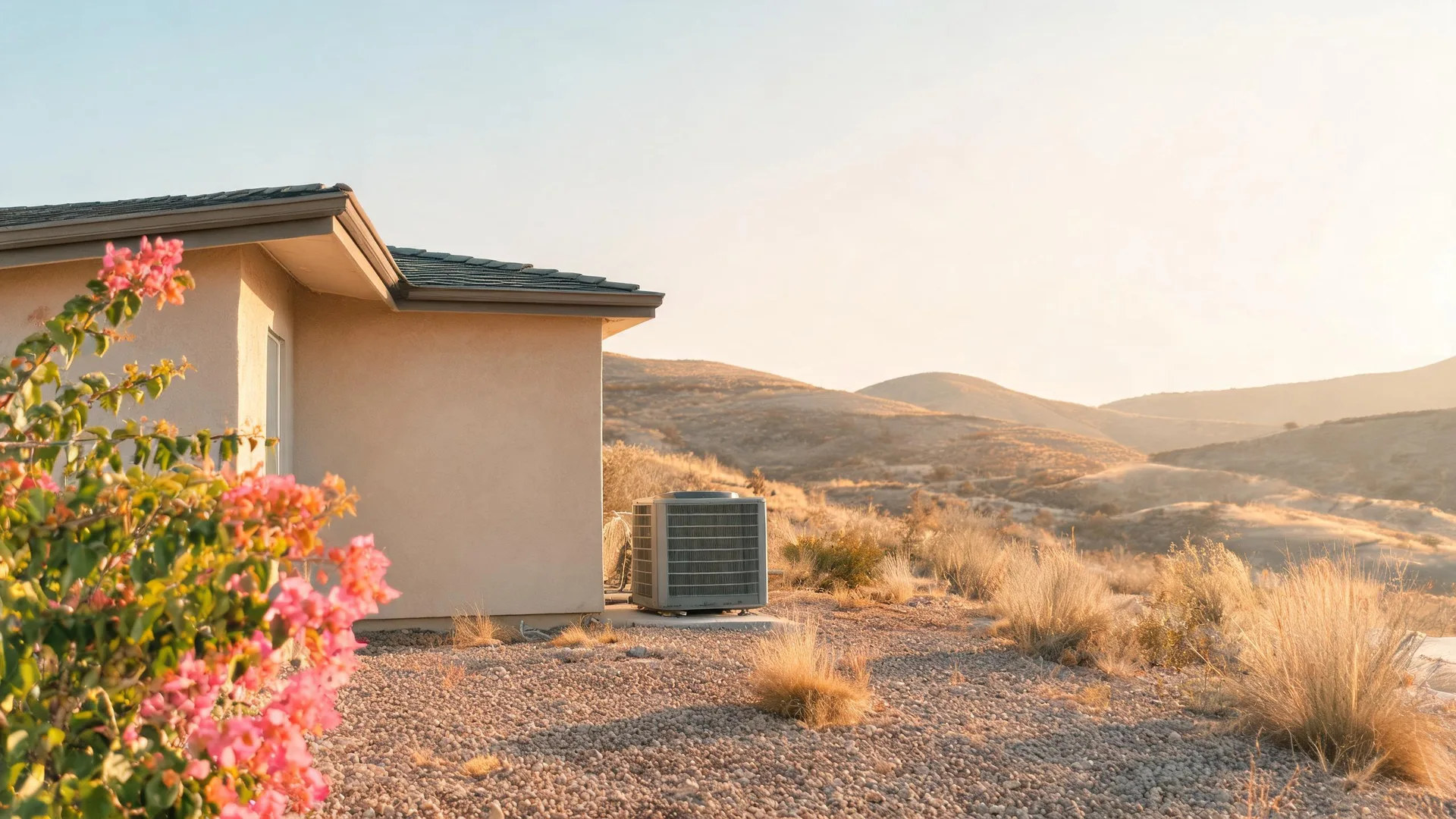
A gray heat pump outdoor unit mounted on a concrete pad next to the stone-accented exterior wall of a house.

The label is tested in a lab, not in your house

The rating on the label comes from a lab test, fixed indoor temperature, fixed airflow, conditions your house won't match exactly. That doesn't make it meaningless. It still tells you how much heat the unit moves for the electricity it draws, measured against another unit tested the same way. A higher rating means less run time to do the same job, and that shows up most on the days the compressor is working hardest. What the rating can't tell you is how the unit performs in your house, because that comes down to whether the ductwork moves enough air, whether the house holds a set temperature well, and whether the unit was sized to the space instead of guessed at. A home with leaky ducts or an oversized unit won't see what the label promises, even with the exact same equipment next door. Treat the rating as the floor the equipment has to clear, not the answer to what your bill will look like.

The outdoor unit's refrigerant circuit sets the floor

A heat pump has to move heat both directions, so its coil, reversing valve and compressor are built differently than a straight air conditioner's. That part of the cost is fixed by the equipment itself, not by the house it goes into.
What's already there decides what gets added

Line sets, a dedicated electrical circuit, a condensate drain and a spot for the outdoor unit all have to be in place or built new. A home that already has ductwork and electric service sized for this kind of system needs less done to it than one that doesn't, and that's where installations start to differ from each other.

Ask what the unit is rated for in both directions, not just one. A heat pump has a cooling number and a heating number, and a contractor quoting you a system should give you both without being asked. Ask what size they're putting in and what that's based on. A unit sized off square footage alone, with nothing else checked, is a guess dressed up as a number. The right size comes from a load calculation that looks at your windows, your insulation, how the house is laid out. Ask what happens to the ductwork if you already have it. Ducts built for a furnace don't always move the right amount of air for a heat pump, and if they're undersized or leaky, the new equipment inherits that problem instead of fixing it. Ask about the electrical circuit the outdoor unit needs and whether the panel can carry it alongside everything else already pulling from it. And ask what's covered if something's off after install, because sizing and setup matter more to how this equipment performs than which brand's name is on the cabinet.

Installation day starts before anyone touches the outdoor unit. The old equipment comes out first, and if ductwork is staying, the contractor checks it for leaks and airflow before connecting anything new. The line set gets run between the outdoor unit and the indoor coil, and on a heat pump those lines carry refrigerant moving in both directions, so joints and connections get checked with more care than on a straight air conditioner. The electrical circuit gets tied in, tested against what the panel can actually carry alongside everything else in the house. Once the system is in place, it gets charged with refrigerant to the manufacturer's spec and run through both modes, cooling and heating, before anyone calls it done. A system that only gets tested in one direction hasn't really been tested.