Heat pump making a loud noise in San Francisco, CA

RepairHeat PumpSan Francisco County, CA
Step 1 of 2

What ZIP code is the job in?

A loud noise from your heat pump usually points to one of a few things. A rattling sound often means a loose panel or something caught in the outdoor unit. A buzzing noise can mean an electrical problem, like a failing contactor or capacitor. A grinding or squealing sound points to the fan motor bearings wearing out. Clanking or banging that happens when the system switches between heating and cooling can mean a part inside has come loose or broken. With winters as mild as they are here, your heat pump spends a lot of its time on mild heating cycles rather than straining through deep cold, so a new noise showing up now usually means something has shifted or worn loose rather than the system being pushed too hard. Left alone, most of these problems get worse and can mean a bigger repair later, or the system failing when you need it most.

A gray outdoor heat pump unit on a concrete pad beside a house with gray horizontal siding, with conduit and an electrical box on the wall and a shrub at left.

What the sound usually means

A heat pump has a compressor, a fan motor and a reversing valve that switches it between heating and cooling. Each one makes a different sound when it's failing. A compressor going bad often sounds like a loud hum or a pulsing noise. A fan motor with worn bearings whines or squeals. The reversing valve can make a sharp clunk when it shifts. Knowing which part is loud narrows down the repair before anyone opens the unit.

An outdoor air-source heat pump unit with a dark grille stands on a concrete pad beside a white wall and wood-clad facade, surrounded by gravel.

Why mild winters change the picture

Winters in San Francisco County are mild enough that a heat pump here spends a lot of its time in defrost mode, reversing briefly to melt frost off the outdoor coil. That reversal is where a bad reversing valve or a sticking solenoid tends to show up first, since the unit cycles through it so often. A noise that only happens during this switch is worth mentioning when you describe the problem, since it points straight at that part.

Is this noise something to worry about

You probably noticed it from inside the house first, then went out to the side yard or the roof to find where it was coming from. A new rattle or squeal tends to show up more at night, when the street outside is quiet and the unit is the loudest thing around. If the sound comes with the heat pump running longer than it used to, or it short cycles on and off, the unit is working harder to do the same job, and that shows up on your power bill before anything else. A grinding or screeching noise usually means a motor bearing is wearing out, and running it that way can turn a motor replacement into a bigger repair if the motor seizes.

A two-story house with cream horizontal siding, a dark gabled roof, and a white front door, fronted by a lawn, shrubs, and a concrete walkway leading to a sidewalk and street, with large leafy trees on both sides.

Summer air here stays dry, with a dew point averaging 52°F across June, July and August, according to NOAA. That matters for a noisy heat pump because the unit isn't working hard against humidity the way one would in a muggier climate. If yours is grinding or squealing even in this kind of air, the sound is more likely coming from a motor bearing or a worn belt wheel than from a system straining under a heavy load. Low humidity also means the noise probably isn't tied to ice buildup on the coil, which is one less thing to chase down.

NASA POWER T2MDEW

A gray outdoor condenser unit on a concrete pad beside a house with horizontal lap siding, with a metal disconnect box and refrigerant lines on the wall, river rock and mulch to the sides, and a green shrub at right.
A quiet, steady hum like this means the fan and compressor are running the way they should, with nothing loose or blocked.
A dirty outdoor air conditioner condenser unit with debris on its coil grille, sitting on a concrete pad beside a light-colored horizontal siding wall, with bare dirt ground in front and a shrub at right.
Fins packed with leaves and dirt like this make the unit strain, and that strain is where the new noise is coming from.

Why does a heat pump work so hard in San Francisco winters?

  • Winter nights average 45°F

    Nights this cold mean your heat pump runs long stretches to keep up, and a loose part or worn bearing gets louder the longer it runs.

  • Heat runs November through May

    Seven months of regular use is a lot of hours on the compressor and fan motor, and worn parts tend to announce themselves with noise before they fail outright.

  • Power here costs 38.42 cents per kilowatt-hour

    At this rate per kilowatt-hour, a unit straining to compensate for a bad part is also costing you more every month it goes unfixed.

NOAA nClimDiv 1991-2020 · EIA-861 2025

What each part of the noise tells you

  • The reversing valve shifts a heat pump between heating and cooling, and a worn one can make a sharp clunk when it switches.
  • The fan motor sits in the outdoor unit and a failing bearing in it usually sounds like a steady squeal that gets worse over time.
  • A compressor nearing the end of its life often makes a loud clicking right before it starts up, then settles into a hum.
  • Loose mounting bolts let the whole outdoor cabinet vibrate against the pad or the wall it's bolted to, which reads as a rattle.
  • Refrigerant moving through a restricted line can make a hissing or gurgling sound that's different from a simple airflow noise.
  • A bent fan blade hits the housing once per rotation, so the knock comes at a steady, even interval instead of at random.

A heat pump switches direction every time it moves between heating and cooling, and that switch happens inside the reversing valve. When that valve starts to wear, you hear it most at the moment the system changes over, a sharp clunk rather than a steady sound. The outdoor fan motor runs on a bearing, and a worn bearing squeals. It starts quiet and gets louder over weeks, not overnight. The compressor is the part that costs the most to replace, and one that's failing often clicks hard right as it kicks on, then drops into a hum once it's running. None of that is the same as a loose bolt. If the outdoor cabinet isn't fastened down tight to its pad or the wall bracket, the whole box shakes when the compressor and fan run, and that comes across as a rattle rather than a single sound from one part. Refrigerant tells its own story. Moving through a line that's restricted or low, it hisses or gurgles, a different sound than air moving past a dirty coil. A bent fan blade is the easiest to place once you know what to listen for, because it strikes the housing once every rotation. Time it against the blade's spin and the knock lines up, steady and even, not random like a rattle from something loose.

A smiling man with dark curly hair in a dark green henley shirt sits on a light sofa in a living room with large windows, a lamp, shelving, a stone fireplace, and a bowl of popcorn in the foreground.
A smiling man in a dark long-sleeved henley shirt sits on a beige sofa in a living room, with a bowl of popcorn and a remote on the table in the foreground and shelves, a lamp, and a doorway behind him.
A smiling man with graying hair and stubble in a blue henley shirt sits on a gray sofa with cushions in a living room, with a bowl of popcorn on a wooden table in the foreground.
A smiling man in a dark green long-sleeve shirt reclines on a sofa in a dimly lit living room, with a bowl of popcorn on a side table in the foreground and a bookshelf, lamp, and houseplant behind him.

Finding a pro stops being your job

Skip searching for a heat pump pro and answer a few questions instead.

Sending the form costs nothing.

A gray outdoor condenser unit on a concrete pad beside a house with gray lap siding, connected by conduit and refrigerant lines to a wall-mounted disconnect box, with a green shrub and mulch bed at left.

Running the way it should

This is a heat pump at rest: clean fins, a clear pad, nothing loose against the siding. Air moves through it without catching on anything, so the sound it makes is just a low, steady hum from the fan and compressor doing their job.

An outdoor air conditioning or heat pump condenser unit on a concrete pad beside a house with horizontal vinyl siding, a gray electrical disconnect box and conduit on the wall, and a concrete walkway in the foreground.

Straining to keep up

Dirt and age have built up on this one, and that buildup is often where a new noise starts. A unit caked like this has to work harder to pull air through, and the strain shows up as a rattle, a squeal or a hum that's louder than it used to be.

Call Now or Wait It Out

Call Today

  • A new noise that gets louder over a few days usually means a part is wearing out, not loose, and waiting lets it fail the rest of the way.
  • Grinding or a sharp clunk when the system switches between heating and cooling points to the compressor or reversing valve, and both are expensive to replace outright.
  • If the noise shows up alongside weak airflow or the unit short cycling, the system is already struggling to keep up with San Francisco's cold nights.
  • A contractor can open the cabinet, check the fan bearing, the contactor and the valve, and tell you which one it is instead of you guessing from the sound alone.
  • Sending one form gets you matched with someone licensed to work on it, instead of you calling around and explaining the noise over and over to find who's free.

Wait and Watch

  • A rattle that only started after a storm or wind event is often just a loose panel screw or debris caught in the fins, not a failing part.
  • If the sound is steady and hasn't changed in volume or pitch over a week or two, it's less likely to be a part actively breaking down.
  • Clearing leaves and dirt from the outdoor unit yourself and checking for a loose panel costs nothing and rules out the simplest causes first.
  • A hum that's always been there, even a slightly loud one, is probably just how your particular unit has always sounded and not new wear.
  • Watching it for a short while only makes sense if the noise isn't paired with weak heating, a burning smell, or the system shutting off on its own.
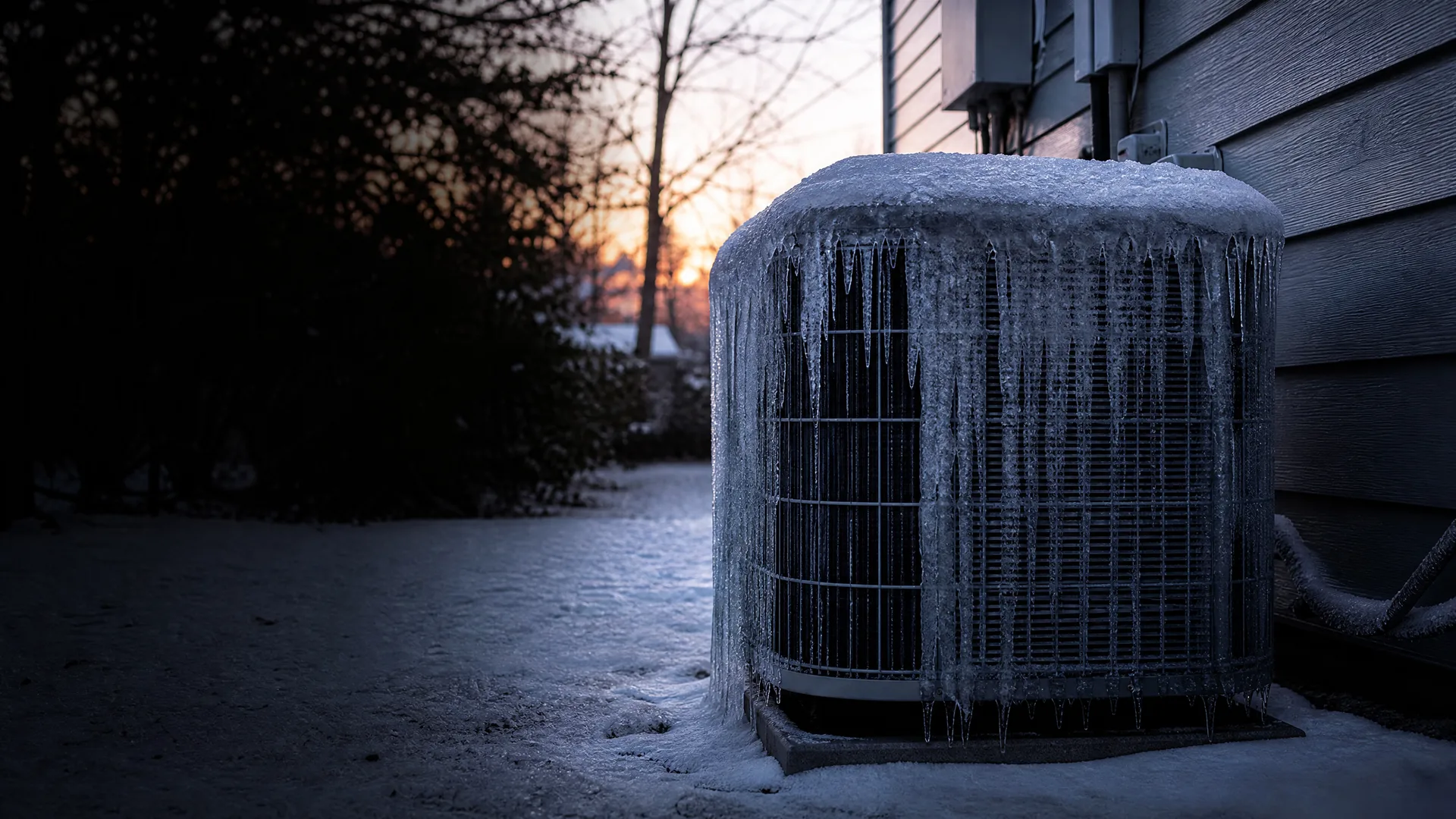
An outdoor condenser unit beside a horizontally sided house, encased in thick ice with hanging icicles, on snow-covered ground at dusk with bare trees and a sunset behind.

Six in the morning, still dark, and you're up before the heat even kicks on. You pass the kitchen window and catch the outdoor unit in the side yard, lit up by the neighbor's porch light. It's coated in ice, thick over the coils, down over the base. The fan isn't turning. You go out in your robe to look closer, and the ice has built up past the fins, packed in solid. No hum, no air moving, just cold metal and frost creeping up the line set. You stand there a minute in the quiet before the street wakes up, trying to figure out how long it's been like this.


A wooden table with a closed laptop, a ceramic mug of dark coffee, and a glass vase of eucalyptus stems beside a window, with a dark green kitchen cabinet, wooden counter, potted herb, cutting boards and bowl blurred in the background.

What to do about the noise

A loud noise from your heat pump is the unit telling you something specific is wrong, not a sign to wait it out. Rattling, buzzing, grinding and clunking each point to a different part, and the sound usually gets worse the longer the system keeps running on it. In a county where most homes heat with gas and this unit carries the cooling load and the shoulder-season heat, those long runs add up fast once something is worn or loose.

You don't have to figure out which part it is before you get help. That's the job of finding the right contractor, calling a few, explaining the noise over and over, and sorting through quotes that don't tell you much without seeing the unit. Send the form once and that search is done. You'll know who's coming, and you can stop listening for whether the noise changed.

Interior corner of a room with a dark upholstered sofa and textured cushion, a potted plant, sheer curtains at a multi-pane window showing blurred green and yellow trees, and a dark table holding a wooden tray with stacked coasters and a small ceramic vase.
A woman with dark hair in a bun reclines on a gray sofa with her eyes closed and a slight smile, wrapped in a cream knit sweater and blanket, with an open book resting in the foreground and a lit lamp in the dim room behind.
A smiling bearded man in a dark crewneck sweater sits at a dinner table with a lit candle, glasses of wine and water, and plates of food in the foreground, with a lamp, framed art and a potted plant behind him.

Let someone else find the pro

A loud noise from your heat pump points to a specific part, and it won't fix itself by running quieter on its own. Instead of searching for a contractor, calling around, and explaining the sound over and over to whoever picks up, send the form once and let a licensed contractor in the San Francisco area take it from there. They'll know what that grinding or buzzing means before they even see the unit, and get it diagnosed.

Start one form

One form replaces the calls you'd make to find a heat pump pro.

You're not committing to anything by asking.