A row of stucco houses with red clay tile roofs seen behind hedges and overhanging tree branches, with a tall stucco wall in the left foreground.

Heat Pump Repair in Hollister, CA

Tell us about the job

Takes about a minute. No obligation.

RepairHeat PumpSan Benito County, CA
Step 1 of 2

What ZIP code is the job in?

Half the homes here were built in 1989 or later

San Benito County splits close to evenly, half the homes built in 1989 or earlier and half in 1989 or later. A heat pump that came with one of the newer houses hasn't logged as many years as one in an older county.


A newer system is usually worth fixing

If your heat pump came with a house built in 1989 or later, the unit is likely still within its working life. A broken part on a system like that is worth repairing rather than writing off.

7 months
November through May, your system heats
4 months
June through September, it cools
37°F
the average winter night it heats against
87°F
the average summer afternoon it cools against
Isometric illustration of a cutaway single-family house showing interior ductwork and an air handler, with an outdoor condenser unit connected by lines along the exterior wall.
Your system heats November through May and cools June through September.

NOAA nClimDiv, 1991–2020 normals

Hollister doesn't throw much at a heat pump. Low dew points all summer and almost no hail.

A heat pump that isn't fighting heavy air or storm damage usually has less wrong with it underneath, so a repair tends to hold.

Fewer hours a year, but each one costs more here

Power here costs 38.55 cents per kilowatt-hour
Climate zone 3C
Cooling runs June through September
The first cold snap in November finds the weak partHeat runs November through May here, so October is the month to get a struggling heat pump looked at.

Don't let a heat pump limp along once something's off. Power here runs among the highest rates in the country, and a bad capacitor or a low charge makes the compressor work harder to do the same job. That shows up on next month's bill before it shows up as a full breakdown. Have someone look at it while the fix is still a small one. Waiting usually just trades a cheap repair for an expensive month.

Fix it. It has less wrong with it than you'd think.

A heat pump that isn't working against heavy air or storm damage has less going wrong inside it. A repair on a unit like that is more likely to fix the actual problem instead of papering over something bigger. Worth getting a tech out to look before you decide it's done.

Find a contractor
A man in a dark jacket, tan work pants and a cap, seen from behind, climbs stone steps toward a blue front door while carrying a canvas tool bag, with a blue planter of greenery at left.
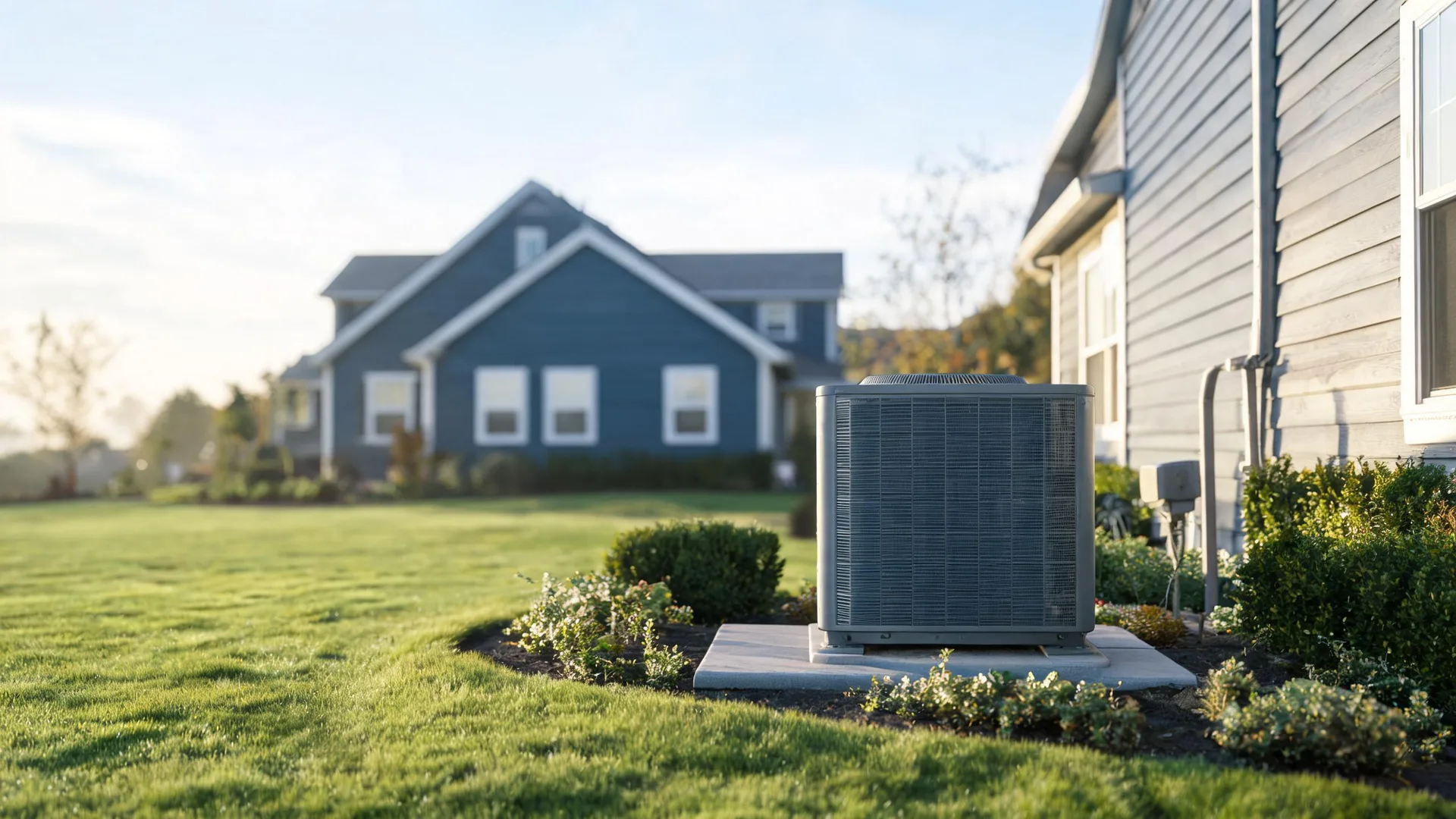
A white mini-split heat pump outdoor unit mounted on a concrete pad beside a gray-sided house, surrounded by gravel and green shrubs.

Find out how old it is before you decide

If your heat pump came with the house, check the paperwork or the date on the unit's nameplate before you decide anything. A system installed when the house was built, in 1989 or later, hasn't put in the years an older unit has. That changes what a repair is worth doing. A compressor or board replacement on a unit with years left in it is money spent on something that'll keep running. Get the age first, then get the diagnosis.

A refrigerant leak doesn't stay small

A heat pump low on charge will still run, so it's easy to leave alone. But the compressor is built to pump refrigerant, not air, and a low charge makes it pull harder on every cycle to move heat at all. Run it long enough in that state and the compressor itself wears out. What started as a leak you could have sealed turns into a compressor you have to replace.

A noise you ignore becomes a part you replace

A squeal from the fan motor or a hard knock from the compressor is usually a bearing or mount starting to fail. The machine will often keep running through it for a while. Left alone, that worn bearing lets the motor run rough enough to burn out the windings, or a loose part works itself free and damages whatever it hits on the way. Caught early it's a bearing or a mount. Caught late it's the whole motor.

A heat pump that needs attention usually tells you before it quits outright. It might run longer than it used to without the house feeling any different, or blow air that's warm but not quite warm enough. Short cycling is another one: the unit kicks on, runs a couple minutes, shuts off, then starts again soon after, never settling into a normal run. Ice on the outdoor coil in weather that isn't cold enough to explain it points to a defrost problem or low refrigerant. A hissing or bubbling sound near the lines usually means a leak. None of these mean the system is done. They mean something specific inside it is failing, and the sooner a tech sees it, the more likely it's one part instead of several.

A tech weighing repair against replacement isn't just looking at what's broken. The compressor is the part that matters most, because it's the one part that isn't practical to replace on its own. If the compressor is sound and the problem is a capacitor, a contactor, a fan motor or a control board, that's a straightforward repair, even if it's not cheap. If the compressor itself is failing, that's a different conversation, since a compressor swap costs enough that it starts to compete with putting that money toward a new system instead. Age factors in too, but not on its own. A unit near the end of its expected life that needs a major part is a worse bet than the same repair on a younger system, because whatever failed once tends to get company. A tech who's actually looked at the unit can tell you which situation this is.