White stucco Spanish Colonial Revival houses with illuminated windows sit among trees on a hillside at dusk, beneath a deep blue twilight sky.

Furnace Repair in Santa Cruz, CA

Tell us about the job

Takes about a minute. No obligation.

RepairFurnace or heatingSanta Cruz County, CA
Step 1 of 2

What ZIP code is the job in?

Storms here do real damage

Santa Cruz County logged 228 severe weather events between 2015 and 2024, with damaging wind alone hitting 207 times. Hail showed up 15 times, and three tornadoes touched down in that same stretch. A furnace sits indoors, but the outdoor power connection and any venting near the roof take the brunt of that weather.

Power cuts hit your furnace too

Most gas furnaces here still need electricity to run the blower and ignition. Across California, 17% of households lost power for 24 hours or more in 2024. When the power drops, a gas furnace stops working the same as anything else.

7 months
November through May, your furnace is on duty
41°F
the average winter night it heats against
57%
of homes here heat with gas, so most furnaces here burn gas
3 winter storms
in ten years, the nights a failure hurts most
Isometric grayscale illustration of a cutaway house showing an interior furnace with a tall flue pipe and ductwork running to rooms under a partially lifted roof.
Your furnace works hardest from November through April.

NOAA nClimDiv, 1991–2020 normals

A furnace fails most often at the igniter or the flame sensor, not the burners themselves.

Clean that sensor or swap a cracked igniter and the furnace runs like nothing happened.

Seven months of mild duty means your furnace isn't working as hard as you'd think

Heat runs November through May
Winter nights average 41°F
Climate zone 3C
November is when a weak part finally gets found outHeat runs November through May here, and the first cold nights put the most strain on whatever was already borderline.

Since the furnace only runs November through May, a repair now is money spent on a machine that still has an easy road ahead of it. Seven months of mild duty wears differently than a furnace running flat out against a hard winter somewhere else. If yours is acting up, that points toward a worn part doing a light job, not a system worked past its limit. Get the igniter or flame sensor looked at before you think about replacement. Most of what goes wrong on a furnace with this kind of workload is a fair fix, not a sign the whole unit is done.

Had storm damage this year? Get the furnace checked before you need it.

If your furnace's outdoor power connection or roof venting took hail or wind this year, get it looked at now, even if the furnace still runs. A part stressed by weather can fail on the first cold night that asks something of it.

Find a contractor
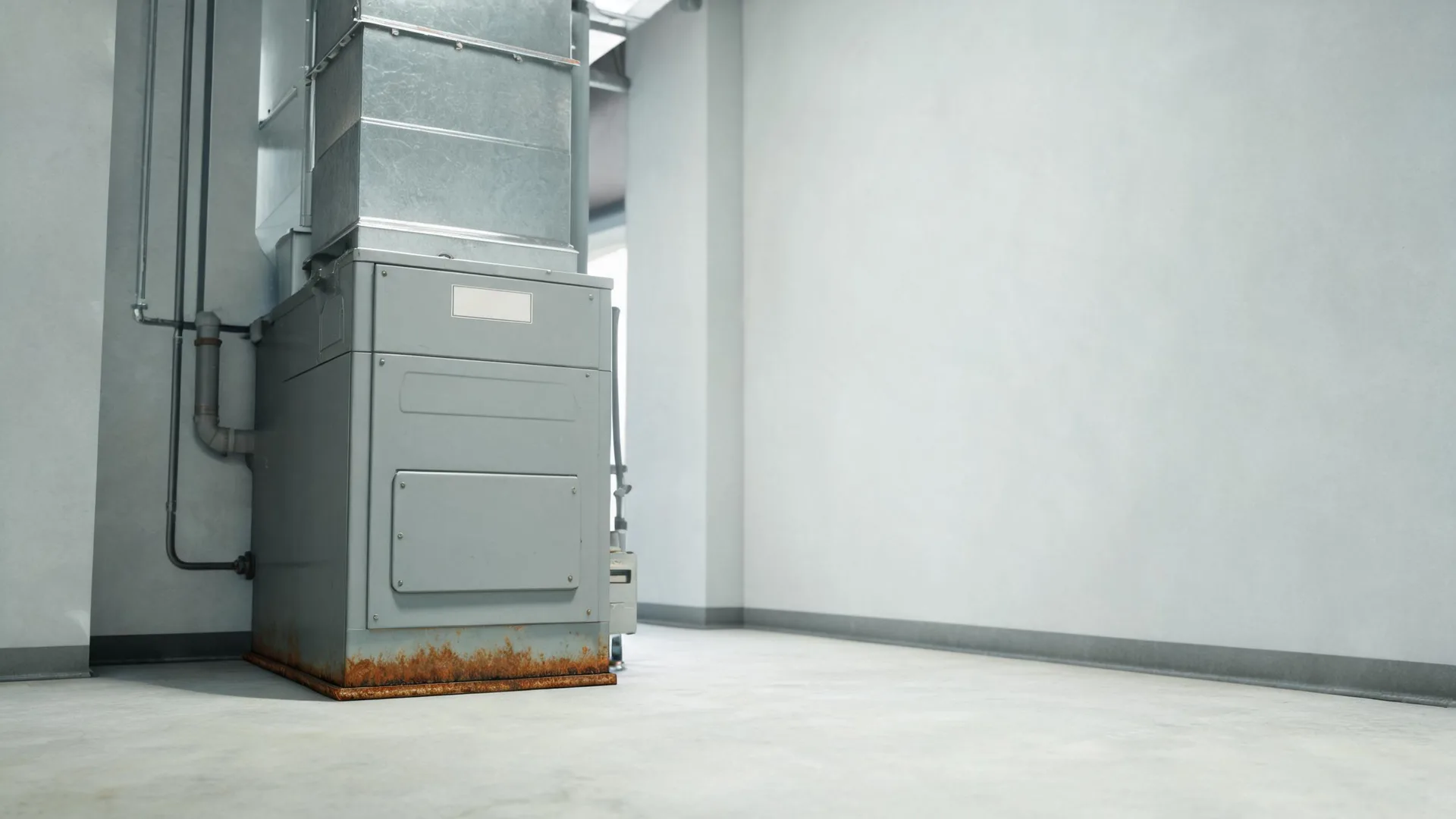
A gray residential gas furnace installed in an unfinished basement, surrounded by ductwork, a metal flue pipe, and a gas supply line.

Some furnace problems hold still. Others don't.

A cracked heat exchanger is the one that matters most, and it only gets worse with runtime. Heat makes the metal expand, and a crack that's barely open when the furnace is cold can pull wider every time the burners fire. Running it keeps pushing combustion gas toward the air your blower moves through the house. A flame sensor caked with residue works the same way in miniature: the furnace shuts off early, you restart it, and each short cycle adds a little more soot to the thing that's already failing. The blower motor tells a different story. A motor running on a worn bearing will often keep going for a long stretch, getting louder and hotter, until it seizes without much warning. None of these fail on the same schedule, which is why the same advice, shut it down and get it looked at, applies to all of them. A furnace that's struggling once rarely fixes itself by continuing to run.

What a bad limit switch looks like from the couch

The furnace runs for a few minutes, shuts off, then starts again on its own a while later. That short-cycling is usually the limit switch reacting to heat buildup inside the cabinet, often because airflow is restricted somewhere. It's not something to wait out. Each cycle like that is the furnace telling you it's shutting itself down to avoid a bigger problem.

A yellow flame means stop and call someone

A gas burner flame should be steady and blue. If it's flickering yellow or orange, the gas isn't burning clean, and that points to a combustion problem worth taking seriously. Turn the furnace off at the switch and don't run it again until someone's checked it. That flame color can mean carbon monoxide is getting made and not vented the way it should be.

A gray forced-air furnace with ductwork stands in an unfinished concrete basement surrounded by storage items and clutter.

A new furnace would cut about $70 a year off heating for a typical Santa Cruz County home.

  • A new high-efficiency furnace$310 a year
  • An older furnace$380 a year

Estimates for a typical Santa Cruz County home, compared with an older unit built to the previous federal minimum, from EIA household energy data, California fuel prices and NOAA climate normals. Your home will differ.

Repair makes sense when one part has failed and the heat exchanger is sound.

Replacement makes sense when the heat exchanger is cracked or the furnace keeps needing parts.

A diagnostic starts before any panel comes off. The tech wants to know what the furnace is doing: short cycling, no heat at all, a smell, a sound, a flame color. Then the cover comes off and the burners get watched through a full cycle, because a lot of problems only show up at ignition or right before shutoff. From there it's a set of checks in order: the flame sensor for a coating that would make it mistake a lit burner for an unlit one, the igniter for a hairline crack, the limit switch and pressure switch for proper response, the blower for how it sounds and how it draws air. A combustion analyzer or a simple visual check tells the tech whether the flame is burning clean. Gas pressure gets checked too, since too much or too little changes how the flame behaves at the burner. Most of this takes longer to explain than it does to do, and by the end the tech should be able to point to the one part causing the trouble rather than guessing at a few.