






A row of single-story stucco houses with red clay tile roofs behind a long cream perimeter wall, shaded by large leafy trees, with trimmed hedges and shrubs along the sidewalk.

Heat Pump Repair in Anaheim, CA

Tell us about the job

Takes about a minute. No obligation.

RepairHeat PumpOrange County, CA
Step 1 of 2

What ZIP code is the job in?

November is the last easy month before this system has to work for heat, and May is the last easy month before it has to work for cooling. A heat pump that was already weak tends to show it right when that switch happens, not before. Something marginal, like a low charge or a worn contactor, can limp along for weeks and then give out the first cold night in December or the first hot stretch in June. If yours just started acting up, that timing is the clue. It usually means a part was already failing and the new load found it.

4 months
December through March, your system heats
5 months
June through October, it cools
47°F
the average winter night it heats against
82°F
the average summer afternoon it cools against
Isometric line illustration of a cutaway single-story house showing interior rooms with furniture and ceiling ductwork, connected to an outdoor condenser unit on the ground outside the left wall.
Your system heats December through March and cools June through October.

NOAA nClimDiv, 1991–2020 normals

A diagnostic visit means finding the part that failed, not guessing at it.

Someone checks refrigerant pressures, electrical draw, and airflow before touching anything, so the part that gets replaced is the right one.

Anaheim doesn't stress a heat pump. A failing part does.

Power costs 31.97 cents a kWh statewide
138 damaging wind events from 2015 to 2024
3 hail events from 2015 to 2024
Home age here doesn't change the diagnosisHalf the homes in Orange County were built in 1977 or earlier, half in 1977 or later. A heat pump wears the same either way.

A heat pump in trouble usually tells you in the air coming out of the vents. It runs but blows air that feels barely warm, or barely cool, instead of shutting off once the room is comfortable. Short cycling is another sign. The unit kicks on, runs a couple minutes, shuts off, then starts again a few minutes later. That often means the compressor is struggling or a sensor is feeding it bad information. Ice building up on the outdoor unit when it shouldn't be there points to a refrigerant problem or a failing defrost control. If the system switches to backup heat on its own, or won't switch between heating and cooling at all, the reversing valve is usually the culprit. None of these fix themselves.

A heat pump this easy on itself is usually worth fixing

A heat pump that hasn't had to fight the weather is usually worth repairing rather than replacing. Get the actual part diagnosed and most of the time that's the end of it.

Find a contractor
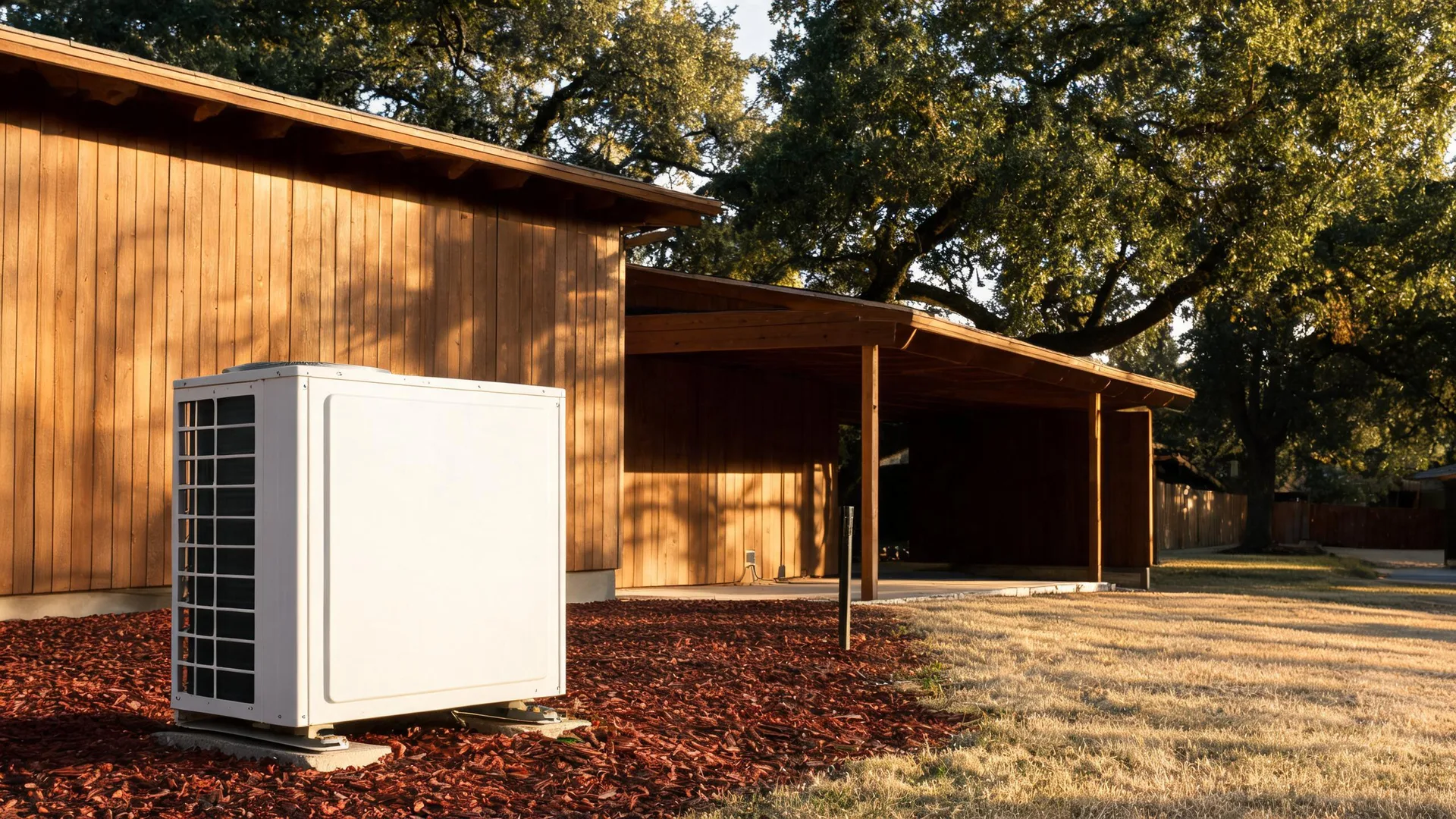
A white mini-split heat pump outdoor unit mounted on a concrete pad beside a gray-sided house, surrounded by gravel and green shrubs.

What to check before you call anyone

Before anyone comes out, check the thermostat is set to the mode you want, heat or cool, and that the batteries aren't dead. Go to the breaker panel and look for a tripped breaker. A heat pump usually has separate breakers for the indoor air handler and the outdoor unit, so check both. Walk out to the outdoor unit and look for anything blocking the sides or the top, leaves, a cover, overgrown branches, and clear it off. Check the air filter. A filter choked with dust starves the system of airflow and can make a perfectly good unit seem weak. Walk the inside of the house and make sure no vents are closed or blocked by furniture or rugs. If the outdoor unit is caked in ice and it isn't mid defrost cycle, leave it alone, chipping at it or pouring water on it can damage the coil underneath. None of this fixes a bad capacitor or a low refrigerant charge, but it clears away everything simple first, so whoever comes out can go straight at the real problem.

Most failures start with a part, not the whole system

A capacitor weakens and the compressor or fan motor struggles to start. A contactor's contacts pit and burn from years of switching on and off, until one day they stick or stop connecting. These are wear parts. They're built to fail eventually, and they rarely give much warning before they do.
What that means for getting it fixed

If a single part caused the failure, replacing that part is usually the whole job. The rest of the system, the compressor, the coils, the ductwork, keeps working fine once the bad part is swapped out. That's why it's worth having someone diagnose which part failed before assuming the unit itself is done.

A heat pump that's struggling still moves refrigerant, still cycles the compressor, still asks the same motor to start again and again. None of that gets easier just because you let it keep going. A low refrigerant charge makes the compressor work harder to move what's left, and that heat has nowhere to go but into the compressor itself. A weak capacitor forces the motor to pull extra current every time it tries to start, and each hard start wears it down a little more. Ice on the coil blocks airflow, so the system pulls in less heat and runs longer to make up for it, which only builds more ice. Left alone, a worn part rarely stays a small problem. It usually takes the compressor down with it, and the compressor is the part everything else in the system depends on.

So how do you tell if a given repair is worth it. Ask what actually failed. A capacitor, a contactor, a fan motor, a sensor, those are straightforward swaps, and the rest of the unit is none the worse for it afterward. The harder case is the compressor. It sits at the center of the system, and everything downstream depends on it. Replacing a compressor starts to compete with the cost of a new system, because the compressor is most of what you're paying for in a heat pump to begin with. That's the real question for whoever diagnoses it. Is this a part failing, or is this the compressor.