






A row of cream stucco houses with red tile roofs behind trimmed hedges and shrubs, framed by a stucco wall in the foreground and overhanging tree branches above.

Heat Pump Repair in San Luis Obispo, CA

Tell us about the job

Takes about a minute. No obligation.

RepairHeat PumpSan Luis Obispo County, CA
Step 1 of 2

What ZIP code is the job in?

A heat pump works harder when the air is thick with moisture, and here it isn't. Summer dew points in San Luis Obispo County average 47 degrees, lower than most of the country sees. Less moisture in the air means the system isn't pulling as much out of it, so the coil and the compressor aren't straining the way they would somewhere muggy. The wind here can get rough, with 27 damaging wind events across the county between 2015 and 2024, so an outdoor unit might take a hit from debris or a branch now and then. But day to day, the work this machine does is lighter than what the same unit would face in a lot of other places. If yours is acting up, it's more likely a specific part wearing out than a machine run into the ground.

6 months
November through April, your system heats
4 months
June through September, it cools
38°F
the average winter night it heats against
87°F
the average summer afternoon it cools against
Isometric illustration of a cutaway single-story house showing interior ductwork and an air handler connected by lines to an outdoor condenser unit on a pad beside the building.
Your system heats November through April and cools June through September.

NOAA nClimDiv, 1991–2020 normals

Half the homes in San Luis Obispo County were built in 1983 or later.

A heat pump that came with a newer house usually has years left in it, which makes repair the right first call.

Power here costs too much to run a heat pump that isn't working right

Power here costs 38.55 cents per kilowatt-hour
27 damaging wind events from 2015 to 2024
Winter nights average 38°F
Call before the first cold morningHeat here starts in November, and trouble usually shows up the week it does

A heat pump that's short cycling, running constantly, or blowing air that isn't the right temperature is pulling power the whole time it does it, and power here costs more than almost anywhere else in the country. That's a reason to get it looked at this week, not next month. Most of what goes wrong is a single part, a contactor, a capacitor, a low charge, and a contractor can usually track it down in one visit. Given what homes here are running on, a repair that takes a bad system and makes it run right again pays for the visit pretty fast.

A lighter workload means this is usually a fix, not a replacement

Your outdoor unit isn't working against the strain a lot of other places put on this kind of system, so when something's off, it's usually one worn part, not a machine on its last leg. Worth getting it checked and fixed rather than replaced.

Find a contractor
A gray air-source heat pump mounted on a concrete pad next to a house with gray vinyl siding, surrounded by gravel and flanked by green shrubs and white hydrangea flowers.

How many years has this one got left

If your heat pump came with the house, check when that was. A system installed when the house was built, or anytime after, has been running against a lighter load than most of the country sees, year after year. That adds up to real life left in the equipment even after it's put in a lot of hours. Worth asking the contractor straight out how many years a unit like yours usually has, and whether what's wrong now is worth fixing against that.

A warning sign is cheap, a failure is not

A heat pump that trips a breaker, ices over, or makes a grinding noise is telling you to shut it off, not push through. A compressor running on a weak capacitor draws more current than it should, and the longer it runs that way, the more heat builds up in the windings. Keep it running and a part that would have cost a service call to replace can take the compressor down with it, and the compressor is the part you don't want to lose.
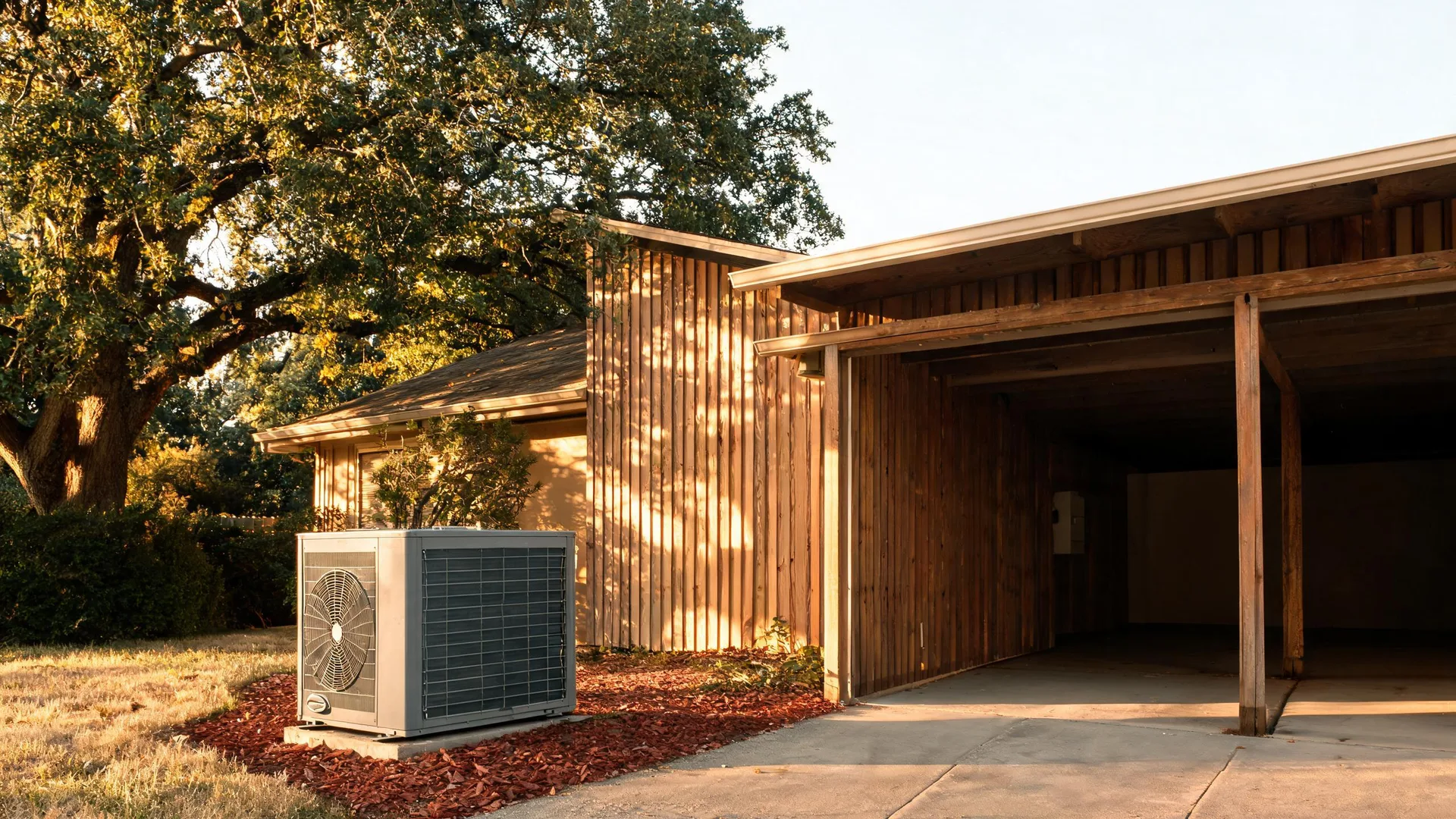
Some problems only get worse with a technician out there

A refrigerant leak doesn't heal itself. Every cycle the system runs low, the compressor pumps harder to move the same heat, and it runs hotter doing it. A frozen coil is the same story: ice blocks airflow, the system keeps calling for more runtime to compensate, and the coil stays frozen longer each time. Shutting it down when something's clearly wrong usually costs less than letting it limp through another week.

Most heat pump trouble shows up as a change you can feel before you can name it. Air coming out of the vents that doesn't feel hot enough in winter or cold enough in summer, even though the system is running. A unit that cycles on and off every few minutes instead of settling into a long steady run. One that runs and runs without ever seeming to catch up to the thermostat. Ice on the outdoor coil when it should be clear, or the outdoor fan spinning while nothing else seems to happen. A hissing or bubbling sound near the lines, a burning smell from the indoor unit, or a breaker that trips more than once. Any of these is the system telling you a specific part is failing, a contactor, a capacitor, a reversing valve, before it fails completely. Catching it at the sign is almost always cheaper and simpler than waiting for the breakdown.

Age by itself doesn't tell you whether to repair a heat pump. What matters is what's actually failing. A compressor is the one part that's expensive enough and hard enough to replace that it changes the math, so when a contractor says the compressor is going, that's worth weighing seriously. A capacitor, a contactor, a fan motor, a reversing valve, those are routine. They wear out on their own schedule, independent of how old the system is, and swapping one doesn't say anything bad about the rest of the unit. A system that's otherwise sound and losing one of those parts is worth fixing almost every time. The question to ask isn't how old is it, it's what exactly is wrong, and is that one part or several at once.